Library Thought Leaders

On April 8, 2015, dolly m (@loather) tweeted the following:

https://twitter.com/loather/status/585900396238938112

dolly m pithily sums up something I’ve been wrestling with for the past few years, ever since I started working in a public library:

There are so-named “thought leaders” in the library community who make their living telling the rest of us how we should do our jobs. They travel from conference to conference, keynoting and presenting, speaking about the current state of librarianship.

Several of these thought leaders haven’t worked as librarians in an actual library in a long time. Some not since before the internet existed. Some of them have no first-hand experience of the practical realities of being a librarian in the Digital Information Age.

This makes it hard swallow when they presume to tell me how I should do my job.

Continue reading “Library Thought Leaders” →

Public Library Reference: An Unscientific Test

I debated for several weeks about writing this post. Some of what I want to talk about I already discussed in my post, The Pain of Bad Reference Interactions. I think there’s more to say, though.

My concern is that I have some strong criticisms of the reference interactions I’ve had with some public libraries in the United States. I use no names and I leave out all identifying details—but it’s still possible that some of these libraries, or even some of their librarians, will be able to recognize themselves if they read this.

I have no desire to shame anyone with this post. I find online public shaming culture abhorrent and I refuse to participate in it.

I believe that criticism is necessary for improvement. I offer all criticisms in the sincere hope that it will help us all to serve our communities even better than we already do, and in my desire to help define the best path forward for public libraries in the Digital Information Age.

Continue reading “Public Library Reference: An Unscientific Test” →

The Pain of Bad Reference Interactions

People love to ask the question, “Why go to the library when you can just Google everything?” In answer, we tend to fall back on some version of Neil Gaiman’s famous quote:

Google can bring you back 100,000 answers. A librarian can bring you back the right one.

We talk about the authority of librarians, our ability to sift through the vast oceans of data with a far better eye toward quality than any search engine can match. We talk about the personalization of the interaction—librarians can recognize not just the right answer, but the answer that’s right for you.

Often, people don’t know how to ask their question. Google is stuck with whatever you enter—if you ask your question the wrong way then you only get results that aren’t what you need, and you’re left to your own devices to try and figure out what went wrong. A librarian can figure out what you really meant and guide your search, to bring you information that’s actually useful in a much more intuitive and rewarding way.

I agree with all of the above. Librarians can serve people’s information needs in ways that Google, or any other online search engine, simply can’t.

Which is why it especially pains me every time I have a bad reference interaction.

Continue reading “The Pain of Bad Reference Interactions” →

Education in America: An Expanded Argument

I keep thinking about my latest posts on education and the need I see for a three-legged balance between STEM, liberal arts, and vocational training. It occurs to me that this is incomplete. There needs to be a fourth leg:

Arts education.

Music, visual arts, performing arts—these are different from liberal arts (philosophy, history, literature study, rhetoric, etc.), just as liberal arts are different from STEM. But just like liberal arts and STEM, arts education also seeks to develop critical thinking skills, along its own lines and according to its own standards.

When I critiqued the STEAM concept, I did so in terms of liberal arts but that’s incorrect. The “A” in STEAM stands for “Arts”—as in arts education, not liberal.

I think my critique still stands: integrating arts education with STEM is a mistake. I believe that conflating them makes it virtually impossible to avoid subordinating the arts aspect to the STEM aspect. They’re both best served when they’re allowed to stand on their own.

A four-legged educational system: STEM—Liberal arts—Arts—Vocational training.

That should be our goal.

The Relevance of Libraries

On April 10, 2015, KCUR’s “Up to Date” program interviewed Prof. John Palfrey about the future of libraries in the Digital Age, the day after he gave a talk on the subject at the Kansas City Public Library. During the interview, KCUR tweeted a question meant to provoke discussion about the future of libraries:

Prof. Palfrey offers an optimistic and robust vision for the future of libraries, but even he frames the discussion in a way that implicitly fuels the fire for those who question their relevance.

I’ve spent a lot of time looking at the data and I have to say—I can’t understand how the relevance of libraries has come into question in the first place. It bothers me that we’ve allowed this question to define the discussion about their future. I can’t think of any other public or civic institution or service that can boast the kind of numbers that libraries do. I tweet-stormed some of the most powerful:

Continue reading “The Relevance of Libraries” →

The Role of Fiction in the Democratic Process

I talk a lot about the democratic mission of public libraries. I believe in it deeply.

However, if we believe that the core purpose of a library is to promote a well-informed democracy, it leads to an essential—and rather uncomfortable—question:

Why do we spend so much time and money maintaining popular entertainment collections if our duty is to provide materials that support our patrons’ involvement in our processes of governance?

What exactly does a library’s popular fiction collection have to do with promoting informed democratic elections? How does easy access to movies and TV shows serve to educate voters? *

Continue reading “The Role of Fiction in the Democratic Process” →

STEAM

A couple of people responded to my previous post about education and the need for three pillars: liberal arts + STEM + vocational training. They point out that a movement exists to expand STEM to STEAM—to integrate arts education into STEM education.

I disagree with this idea. I’m convinced that liberal arts and STEM education need to be allowed to flourish each on their own and to interact with each other as equals. I feel that STEAM initiatives intrinsically subordinate the arts aspect to the larger STEM aspect.

But my concern about STEAM speaks to something deeper. At their cores, both liberal arts and STEM educations seek to teach strong critical thinking skills. They use very different methodologies to do so, and are based on different structures of reasoning, logic, discourse, etc.

I know many people for whom STEM education doesn’t work. Their minds simply don’t respond to that teaching methodology, to those structures of knowledge. Likewise, I know many people for whom liberal arts education doesn’t work and for the same reasons.

If the goal is to promote critical thinking skills, it’s obvious to me that we need to maintain multiple avenues for people to get there.

Intentionally conflating different educational methodologies and pathways is a mistake. Cramming them together narrows the options available for people to learn the critical thinking skills they need in ways that are best suited to them.

I believe that this can only reduce the efficacy of education overall.

Public Libraries: STEM, Maker Spaces & the State of Modern Education

Please read this article. He makes an important point. The headline, as always, is composed to be divisive—his argument is more nuanced than the headline lets on.

Why America’s obsession with STEM education is dangerous by Fareed Zakaria (posted by The Washington Post on March 26, 2015)

Let me start with this: STEM education is important. Despite the headline, this article doesn’t try to argue that it isn’t important.

Looking back at the history of education in this country, it seems to me that we were at our best, our strongest and most successful, when we had a balance across three arenas of study: liberal arts + STEM + vocational training. We need all three, equally. Liberal arts, in particular, is what stood us apart from much of the rest of the world during the 20th century. We also had far-and-away the most robust and most affordable vocational training in the world during the middle section of the century.

Liberal arts tracks have been under attack for pretty much my entire life, and prior. Vocational training in this country has been utterly gutted over the past decades. STEM education is important but I also worry that we emphasize it at the expense of reestablishing this three-pillared balance.

Continue reading “Public Libraries: STEM, Maker Spaces & the State of Modern Education” →

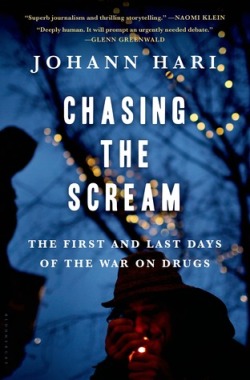
Book Review: Chasing the Scream by Johann Hari

Chasing the Scream book cover
Chasing the Scream: The First and Last Days of the War on Drugs by Johann Hari
Bloomsbury USA, 2015

I believe that Chasing the Scream: The First and Last Days of the War on Drugs by Johann Hari is one of the most important books currently on our shelves. I think most people are aware that the war on drugs has been an abysmal failure. What this book reveals about the origins and history of that war goes a long way towards explaining why.

Essentially, Mr. Hari argues that the approach we’ve taken to drugs for the past 100 years is worse than merely a failure—the war on drugs has been just about the worst possible approach we could have taken. It’s doing tremendous damage to our society. It’s the opposite of what we should be doing. Moreover, it’s a hugely hypocritical policy that ensconces deeply racist attitudes. He backs up these claims with numerous examples from the history of the drug war.

Far more important, however, is Mr. Hari’s exploration of alternatives. There are better options available to us to deal with the problem of drug use and the violence that accompanies drug culture. We already have compelling data to show that some of these alternative options actually work—options that are based on compassion, rather than vilification; healing, rather than criminalizing.

Continue reading “Book Review: Chasing the Scream by Johann Hari” →

Teaching Digital Literacy

I’ve spent quite a bit of time over these past few weeks thinking about digital literacy. I try to compare it to reading and language literacy.

The comparison is illustrative.

Consider language literacy:

  • It takes years to learn and master a language.
  • Immersion is universally recognized as the best way to learn a language.
  • The more words and phrases you’re exposed to, the more you’ll learn.
  • You have to start simple and work your way up to the complicated stuff over time.

Consider reading literacy:

  • It takes years to learn how to read.
  • Constant exposure to reading is the best way to learn—being read to, reading on your own.
  • The more you see other people in your daily life reading, the more likely you are to make reading a habit for yourself and the greater your comfort level with reading will be.
  • You have to start simple and work your way up to the complicated stuff over time.

“Years to learn,” “immersion,” “exposure,” “work your way up”—developing literacy is a long process that needs to be a part of your daily life. Literacy involves more than just the mechanical tasks of speaking and reading—it requires habit and a level of comfort.

Continue reading “Teaching Digital Literacy” →