Book Review: Dead on Arrival by Matt Richtel

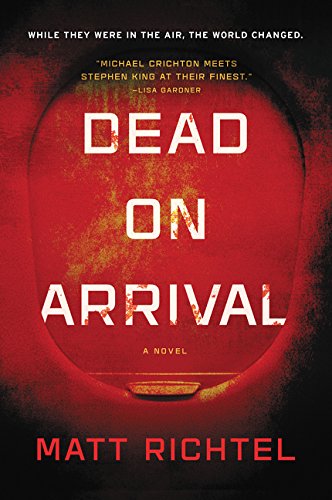
Cover of the book Dead on Arrival by Matt Richtel
Dead on Arrival
by Matt Richtel
Morrow, 2017

This review was first published by Booklist on May 31, 2017.

The promotional blurbs for Richtel’s latest compare it to Michael Crichton’s thrillers and Stephen King’s The Stand, and these comparisons aren’t without some merit. The story is similar in atmosphere and style to both suggestions, and it’s a cautionary tale about technology and science left unchecked. An airplane lands in a remote town and everyone on the ground appears to be dead. A disgraced doctor on board is the best hope to discover what’s going on. The first half of the novel is split between this mystery and flashbacks to the doctor’s past and his relationship to a particular individual who works for an online technology giant. A twist at the midpoint of the book radically changes the direction of the story, and the second half proceeds as a conventional race-against-the-clock thriller. The pacing is excellent, the science is detailed and believable, and the flashback structure is handled well. Richtel’s writing style is urgent, making this an enjoyable and gripping read.

Remembrance of Earth’s Past by Liu Cixin: A Critical Follow-Up

Shortly after I published my review of the “Remembrance of Earth’s Past” trilogy by Liu Cixin, I tweeted a link to it and @ referenced both the author and the two English language translators of the series, Ken Liu and Joel Martinsen. Shortly after that tweet, Ken posted a series of tweets in response.

I’m incredibly grateful that Ken took the time to respond. His tweets are insightful and his critique of my review is helpful. I’ve included them here with his permission. Please read through them.

https://twitter.com/kyliu99/status/858025429793468417 Continue reading “Remembrance of Earth’s Past by Liu Cixin: A Critical Follow-Up”

Book Review: Remembrance of Earth’s Past by Cixin Liu

Remembrance of Earths Past by Cixin Liu

The Three-Body Problem by Cixin Liu
(translated by Ken Liu)
Tor, 2014

The Dark Forest by Cixin Liu
(translated by Joel Martinsen)
Tor, 2015

Death’s End by Cixin Liu
(translated by Ken Liu)
Tor, 2016

In my review of Leviathan Wakes by James S. A. Corey, I compare reading it to reading Asimov’s Foundation when I was a kid.

I’m going to make the same comparison with the “Remembrance of Earth’s Past” series by Cixin Liu. Reading this awakens the same sense of discovery and amazement as reading Asimov when I was a child. Liu gifts us a story that’s astounding in scope and vision, with some of a biggest Big Ideas in science fiction.

The English translations of Liu’s work boast an admirable level of stylistic polish. There’s a spare and refreshing lyricism at work here. I’m as impressed with the quality of the translations as I am with Liu’s story.

This is what science fiction should be. I’m in awe of Liu’s imagination and accomplishment.

Continue reading “Book Review: Remembrance of Earth’s Past by Cixin Liu”

Unreliable Narrators

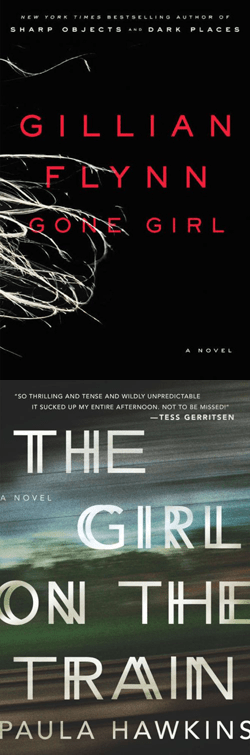
Gone Girl by Gillian Flynn & The Girl on the Train by Paula Hawkins

Gone Girl by Gillian Flynn
Crown, 2012

The Girl on the Train by Paula Hawkins
Riverhead Books, 2015

In 2012, Gillian Flynn published Gone Girl and kick-started our current craze for unreliable narrator stories. 2015 saw the release of The Girl on the Train by Paula Hawkins and the unreliable narrator novel was firmly ensconced.

Rarely have I witnessed two books compared to each other more than these.

Not only was The Girl on the Train trumpeted as “this year’s Gone Girl,” not only did every critic and reviewer on the planet compare the two, but just about everyone I knew picked a favorite and took a side in the which-is-better debate.

Most people I know like both but have a clear preference for one or the other, and there are more than a few who love one and hate the other.

For most, their preference seems to boil down to which narrator appealed to them best. It’s not a matter of which you like best, as neither narrator is intended to be likeable. But both are meant to be intriguing.

I’m convinced that character appeal isn’t all that’s going on here. I think focusing on which narrator appeals the most is circling around a deeper issue.

Continue reading “Unreliable Narrators”

Further Ruminations on Jerusalem by Alan Moore

Reader comments left on a copy of Jerusalem by Alan Moore

Reader comments left on a copy of Jerusalem by Alan Moore

Photo from the ReBound event on March 21, 2017, hosted by the Young Friends of the Kansas City Public Library and KCUR’s Generation Listen KC at the recordBar in Kansas City, Mo.

Image © Kansas City Public Library. Used with permission.

After writing the single longest and most exhaustive review I’ve ever written for Jerusalem by Alan Moore, I find I still have more to say.

I’ve had conversations now with a few other people about this book and discovered that I’m in a minority in my opinion. Most people I know couldn’t stand it. Most didn’t finish it. Mostly, they found it too long, too wordy, too self-indulgent. The general reaction is that Moore desperately needed an editor to reel him in.

I get that. On some level, I feel this way, too. I spent quite a lot of the book convinced that he was over-indulgent and lacking writerly discipline.

However, as others have stated (and I quote Library Journal here), Jerusalem is “[m]ore a work of art than a novel.”

Continue reading “Further Ruminations on Jerusalem by Alan Moore”

Book Review: Take Us to Your Chief and Other Stories by Drew Hayden Taylor

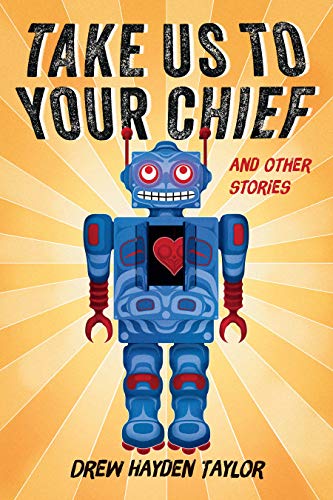
Cover of the book Take Us to Your Chief and Other Stories by Drew Hayden Taylor
Take Us to Your Chief and Other Stories
by Drew Hayden Taylor
Douglas & McIntyre, 2017

This review was first published by Booklist on March 3, 2017.

Taylor is on a mission to create science fiction written by indigenous First Nations authors. That alone makes his collection of short stories important. These nine stories are highly entertaining, the quality is high, and his range of tone is impressive. The First Nations perspective gives an interesting take on the “first contact” theme, paralleling the arrival of Europeans to the Americas. Most of these stories are humorous, but there are a couple serious ones thrown in. Many have a 1950s, Silver Era, silly pop-movie feel, which lends them a nostalgic patina. Unfortunately, the retro feel of these stories is at odds with the progressive goal of the author, coming across a tad dated and frivolous. The collection is a fun and quick read, but as entertaining as these stories are, such a slim volume isn’t quite enough to satisfy. Still, readers will be looking for more to come from Taylor.

Book Review: Avengers of the Moon by Allen Steele

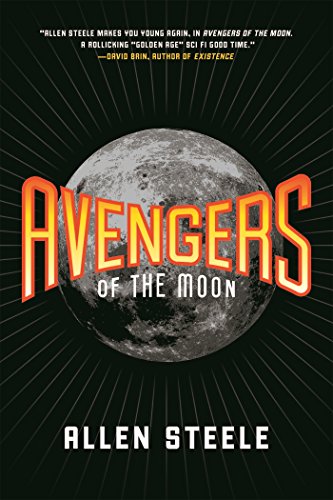
Cover of the book Avengers of the Moon by Allen Steele
Avengers of the Moon
by Allen Steele
Tor, 2017

This review was first published by Booklist on March 3, 2017.

In Avengers of the Moon, Steele resurrects Captain Future, a hero of classic pulp serials created by Edmond Hamilton, and retcons him for the twenty-first century. This all-new origin story introduces Captain Future and his crew to a new audience, pits him against his archnemesis, and sets up a continuing series. It’s a classic rollicking adventure story—exciting and entertaining, with enough callbacks to the original to appeal to existing fans. Steele states in his afterword that his intent is to recapture the magic of old pulp SF, but he doesn’t completely succeed. This isn’t the fault of the book—it’s well written, appropriately pulpy, and fun to read. It’s just that pulp doesn’t necessarily work with a modern audience. The pulp era grew out of a sense of wonder; audiences then possessed a wide-eyed credulity. Modern readers aren’t that credulous anymore. Without that innocence and idealism, pulp SF is an awkward fit. Still, this book is worth reading for the fun of it.

Book Review: Jerusalem by Alan Moore

Jerusalem by Alan Moore
Liverlight, 2016
Cover art © Alan Moore

The greatest challenge about reviewing Jerusalem by Alan Moore is summarizing what it’s about. This isn’t a traditional novel and it doesn’t deliver a normal story. The plot is meandering, almost vestigial in some sections. Setting is paramount—language, tone, atmosphere, characters: all of these matter far more than mere plot.

I’ve come to think of this book as being akin to the Bayeux Tapestry—a sprawling and artistically audacious account of a place and its people. It’s a love letter to a neighborhood as only Moore can write it.

In general terms, it’s a quasi-fictional history of the Boroughs—the poverty-stricken Northampton neighborhood in England where Alan Moore was born, raised, and still lives—from ancient times through the near future, not told in chronological order, and actively eschewing the concept of linear narrative. It’s the story of a unique family who lives there through several generations, and various persons associated with them. It’s a story of the afterlife and eternity and the Universe. It’s a story about life and death, art and work, obligation and free will, ghosts and angles and builders and demons. Visions and dreams are as real in this world as reality.

If I had to categorize this book, I’d probably call it fantastical realism. Everyone is going to shelve it in their SF sections. But it’s more than just these—it’s philosophical, historical, political, religious.

It’s holy and profane, poetic and pedestrian, beautiful and gritty. It’s deeply human. It’s hard to explain. You really need to read it.

Continue reading “Book Review: Jerusalem by Alan Moore”

Movie Review: Rogue One: A Star Wars Story

Rogue One: A Star Wars Story, directed by Gareth Edwards
Rogue One: A Star Wars Story
Directed by Gareth Edwards
Screenplay by Chris Weitz & Tony Gilroy
Story by John Knoll & Gary Whitta
Produced by Lucasfilm, Ltd.
Distributed by Walt Disney Studios, 2016

I finally saw Rogue One: A Star Wars Story this weekend and I’m very happy with it. I enjoyed it immensely and I have many thoughts about it now.

I should point out that I never had much to do with the Expanded Universe—I read a couple of the novels but I never paid much attention to it. I’ve also never watched any of the animated series (“Star Wars: The Clone Wars” or “Star Wars: Rebels”). My reactions to Rogue One come purely from the perspective of how well it fits in with the other movies.

**WARNING: SPOILERS**

Continue reading “Movie Review: Rogue One: A Star Wars Story

Book Review: The Wrong Dead Guy by Richard Kadrey

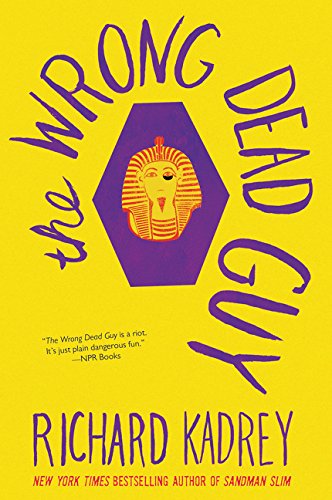
Cover of the book The Wrong Dead Guy by Richard Kadrey
The Wrong Dead Guy
by Richard Kadrey
Harper/Voyager, 2017

This review was first published by Booklist on January 9, 2017.

Coop and company are back for their second supernatural adventure (after The Everything Box, 2016). This time, they’re facing a reanimated mummy bent on world domination (and finding his old girlfriend) while Coop gets acclimated to his new role in DOPS. There are inept suburban animal-rights activists, a crooked used-car salesman, machinating DOPS agents, a possessed museum guard, crooked old mystics, a professor transformed into a cat trapped in a television mounted on a tentacled robot, a forgotten department in the bowels of DOPS with a strange box in it . . . Kadrey fans have plenty of his signature ridiculousness to sink their teeth into: Douglas Adams meets Clive Barker in a James Ellroy setting. This is smart, witty, and biting comedy. There’s a bit of a sophomore slump: the stakes of the conflict are lower than its predecessor, and the side characters feel somewhat perfunctory. Still, all the elements come together and work well, and Kadrey at slightly less than his best remains one of the best out there. This new series remains worthwhile.