Book Review: Probability Shadow by Mark Laporta

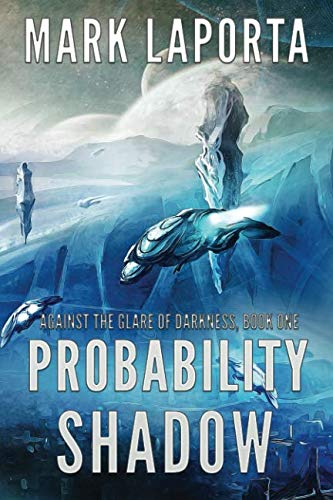
Cover of the book Probability Shadow by Mark Laporta
Probability Shadow
by Mark Laporta
Chickadee Prince, 2018

This review was first published by Booklist on October 4, 2018.

Laporta’s skill with intricate world building is on full display in this first novel of a new trilogy for adults (after Mirror at the Heart of Time, 2017, for teens). He’s created an engrossing far-future reality of galaxy-spanning civilizations, populated by multiple alien races (bodiless symbionts, sentient AI, and mysterious creatures who exist outside of linear time, among others). His imagination is impressive and establishes a delightful playground for the trilogy to explore. This is a political-intrigue story with aspects of military sf and some action sequences. The main character is a diplomat and the conflict is set off by a shortage of vital resources. It’s not the typical fast-paced plot one expects for this kind of setting; that alone makes Probability Shadow interesting. Laporta’s characters are compelling, if drawn rather broadly. The plot gets convoluted and the short chapters make for abrupt transitions, but the sheer scope of his imagination is worth the experience and redeems minor stylistic missteps. The setup for the next book promises an even grander vision.

Book Review: Lost Mars: Stories from the Golden Age of the Red Planet edited by Mike Ashley

Cover of the book Lost Mars: Stories from the Golden Age of the Red Planet edited by Mike Ashley
Lost Mars: Stories from the Golden Age of the Red Planet
edited by Mike Ashley
Univ. of Chicago/British Library, 2018

This review was first published by Booklist on August 20, 2018.

There has been a craze lately for retro and golden-age science fiction, and Lost Mars fits right into that trend, presenting a collection of 10 classic short stories about Mars written between 1887 and 1963. It features works by H. G. Wells, Ray Bradbury, and J. G. Ballard as well as authors less well known to modern audiences. These stories are of the highest quality and illustrate how our evolving understanding of the Red Planet changed the way we wrote about it and how Mars came to occupy a prominent position in our hopes, dreams, and fears as the modern age dawned and grew. Editor Ashley (The Mammoth Book of Time Travel SF, 2013) offers a brief and thoroughly researched introduction which provides background information about both the major Martian discoveries of the nineteenth, twentieth, and twenty-first centuries and the history of Martian science fiction from H. G. Wells through Andy Weir. It serves as a fascinating overview of the history of Mars in science fiction, from the birth of the genre through the beginning of the space age.

Book Review: Resistant by Rachael Sparks

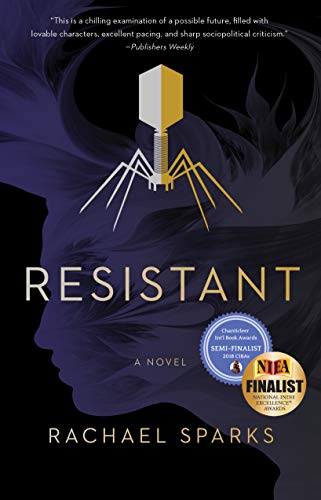
Cover of the book Resistant by Rachael Sparks
Resistant
by Rachael Sparks
SparkPress, 2018

This review was first published by Booklist on August 20, 2018.

In the near future, antibiotic-resistant bacteria have decimated the population. One young woman may hold the cure, and, aided by the Resistance, she is on the run from nefarious government agents. Besieged by betrayals, she must figure out whom to trust and how to save mankind. Sparks’ debut is a thrill ride for readers of biological thrillers like those of Robin Cook. The strong pacing and characterization contribute to an easily believable world with just the right amount of technology to satisfy more traditional sf readers. There is even a dash of romance. Despite the occasional awkward transition and slightly heavy-handed exposition, Resistant is a potent combination of elements, making this a novel that’s sure to appeal to a wide audience.

Movie Review: Solo: A Star Wars Story

Solo: A Star Wars Story directed by Ron Howard
Solo: A Star Wars Story
Directed by Ron Howard
Written by Jonathan & Lawrence Kasdan
Produced by Lucasfilm, Ltd.
Distributed by Walt Disney Studios, 2018

What I find most interesting about Solo: A Star Wars Story is that it doesn’t really feel like a Star Wars movie. That’s mostly a good thing.

What I mean is: it doesn’t feel important. It’s the only Star Wars movie so far that isn’t significant. In the original trilogy, Lucas explicitly sought to create a modern myth, a la Joseph Campbell. There’s an inherent sense of weight to it. The new trilogy sought to bring the Star Wars universe back to relevance and so it has a sense of mission, as well as a similar sense of modern myth. Rogue One tells a tale of emotional, moral, and narrative consequence.

Solo doesn’t have any of that. It’s not important to the main trilogies and it doesn’t take itself all that seriously. Which makes it one of the most fun Star Wars movies I’ve seen. It’s pure entertainment. It’s refreshing.

Continue reading “Movie Review: Solo: A Star Wars Story

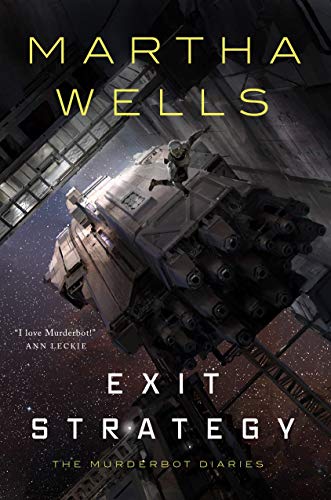
Book Review: Exit Strategy by Martha Wells

Cover of the book Exit Strategy by Martha Wells
Exit Strategy
by Martha Wells
Tor, 2018

This review was first published by Booklist in August, 2018.

After finding evidence proving that the GrayCris Corporation engaged in illegal activities, Murderbot heads out to hand the case over to Dr. Mensah, its former owner. But Dr. Mensah has disappeared, and Murderbot must track her down—straight into the heart of enemy territory. Saving its mentor and taking down GrayCris are just the beginning of its challenges—Murderbot also has to figure out who it is, where it fits in society, and just how it is supposed to relate to all these people. The fourth installment of Wells’ Murderbot Diaries (after Rogue Protocol, 2018) will satisfy readers’ hopes for this series finale. It follows the same basic structural formula as its predecessors, so it has all the action fans expect. Exit Strategy tones down the humor a bit but adds depth to Murderbot’s introspection as it wrestles with questions of identity that it has been avoiding, and the story leaves it to decide its own future. Everything comes full circle while remaining appropriately open ended. Wells gives us a worthy conclusion to one of the best series in recent memory.

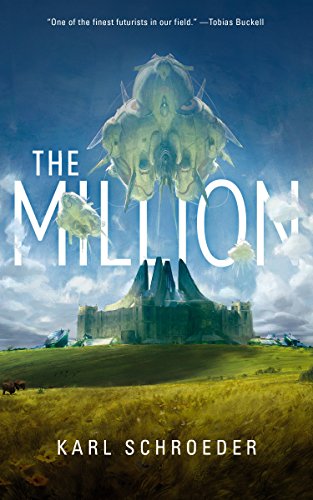
Book Review: The Million by Karl Schroeder

Cover of the book The Million by Karl Schroeder
The Million
by Karl Schroeder
Tor, 2018

This review was first published by Booklist on July 18, 2018.

Schroeder (Lockstep​, 2014) presents an engrossing and unique vision of the future. Most humans have moved off world, and the population of Earth is kept at one million. The Million is made up of families who are custodians of the land and resources, responsible for preserving historic skills and culture, and they’re all incredibly wealthy. Meanwhile, 10 billion people lay in cryogenic hibernation underground, waking for one month every 30 years to overrun the planet. Gavin is a young man who doesn’t belong: he is a visitor secretly adopted by one of the Million. When a rival dies, Gavin takes his place in the Academy, a training school for the elite police force charged with tracking down outcasts like him. What he discovers there is a conspiracy that could tear apart the very fabric of society. Schroeder develops a rich setting for such a short book, slightly strained but elegantly rendered, and it makes the juicy intrigue plausible. His characters are believable and the stakes are high. It’s an exciting start to what should be an addicting series.

This title has been recommended for young adult readers:

YA/General Interest: With young protagonists in a school setting dealing with the machinations of adults in authority, The Million ticks all the right boxes for older teen sf fans.

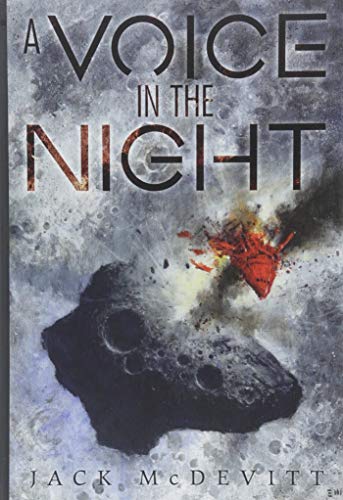
Book Review: A Voice in the Night by Jack McDevitt

Cover of the book A Voice in the Night by Jack McDevitt
A Voice in the Night
by Jack McDevitt
Subterranean, 2018

This review was first published by Booklist on July 5, 2018.

A Voice in the Night brings together 24 short stories by McDevitt (The Long Sunset​, 2018)—tales of space exploration and artificial intelligence, even a couple of alternate-history yarns. Many highlight McDevitt’s concerns about the future of space travel and the unlikelihood of encountering other intelligent life in the universe, as well as worries about the future of our planet. Most of the stories in this collection were published in the past two decades, with a handful from the previous millennium, so it’s not a complete retrospective. Two stories are award-worthy: “Good Intentions” was a Nebula nominee in 1998, and “Ships in the Night” was an International SF winner in 1993. Of particular interest to McDevitt’s readers are two stories from his well-known Academy series, detailing Priscilla Hutchins’ qualification flight when she first became a starship pilot, in addition to several other stories set in the Academy universe. McDevitt’s fans will welcome this collection.

Book Review: Apocalypse Nyx by Kameron Hurley

Cover of the book Apocalypse Nyx by Kameron Hurley
Apocalypse Nyx
by Kameron Hurley
Tachyon, 2018

This review was first published by Booklist on July 5, 2018.

Hurley’s collection revisits the world of the Bel Dame Apocrypha (beginning with God’s War, 2011) with five stories featuring intergalactic bounty hunter Nyxnissa so Dasheem (aka Nyx) and her crew on some of their dangerous jobs. The plots are taut, thrilling, gritty, violent, profane, magical—everything Hurley’s readers expect. New readers will not feel lost in this world—Hurley has created one of the most engrossing environments in modern sf—but fans will delight in learning how Nix meets Khos and the first time she hires Anneke. Though there is not much personal growth, all of the characters are well realized, even in the short story format, and each story covers familiar interpersonal conflicts and emotional highs and lows. These stories were previously published online, but fans of sf adventure stories with lots of political intrigue will welcome them in print.

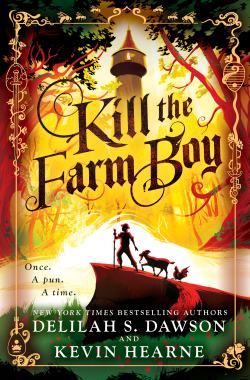
Book Review: Kill the Farm Boy by Delilah S. Dawson and Kevin Hearne

Kill the Farm Boy by Delilah S. Dawson and Kevin Hearne
Kill the Farm Boy
by Delilah S. Dawson and Kevin Hearne
Del Ray, 2018

Kill the Farm Boy is a delight. It’s funny, unexpected, clever. It’s a quick read without sacrificing any substance. The characters are wonderful—interesting, infuriating, and sympathetic by turns—the world is well-rendered and the plot well-paced.

Did I mention it’s funny? Like, really funny. I have high hopes for the series this book sets up.

Fair warning: you better love puns.

I read an advance reader copy of the novel and it came with a summary of the planned marketing and promotional strategy. The marketing for this book emphasizes a comparison with the work of Terry Pratchett. This offers a good way to explore what Kill the Farm Boy is really about.

Continue reading “Book Review: Kill the Farm Boy by Delilah S. Dawson and Kevin Hearne”

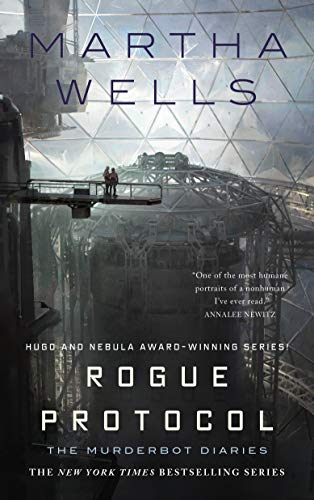
Book Review: Rogue Protocol by Martha Wells

Cover of the book Rogue Protocol by Martha Wells
Rogue Protocol
by Martha Wells
Tor, 2018

This review was first published by Booklist on May 29, 2018.

In Rogue Protocol, the third (after Artificial Condition, 2018) of Wells’ Murderbot Diaries, Murderbot is on a mission to find evidence to bring down the GrayCris Corporation for good. Their journey takes them beyond the Corporate Rim to a derelict terraforming station that hides a secret. Once again, they must protect a human crew, and when their secret identity as a rogue SecUnit is threatened, they have to decide whom they can trust. As always, the story is fast-paced and action-packed, colored by Murderbot’s acerbic commentary throughout. Though the main character remains as appealing as ever, this entry in the series feels less substantial, less happens, the plot and secondary characters are less complex, and there’s more exposition filling the pages. It’s clear the primary purpose of this book is to set the stage for the next one. On its own merits, Rogue Protocol doesn’t quite live up to the first two books in the series, but readers will be thrumming with excitement for what comes next.