Book Review: After the Flare by Deji Bryce Olukotun

Cover of the book After the Flare by Deji Bryce Olukotun
After the Flare
by Deji Bryce Olukotun
Unnamed, 2017

This review was first published by Booklist on August 22, 2017.

A solar flare knocks out electrical grids and technology worldwide. Countries along the equator survive best, so Nigeria ends up with the only functional space program on Earth. With the help of a former NASA engineer, the Nigerian astronauts undertake a daring rescue operation to the International Space Station. Meanwhile, terrorists threaten the launch, and excavations unearth an ancient secret. Olukotun weaves together a broad spectrum of subjects: engineering and archaeology, culture and politics, biohacking and cybernetic animal technology, ancient tribal wisdom and magical stones. With such an original premise, the story is well-paced, with compelling characters and a subtle sense of humor. It’s particularly fascinating to witness the culture shock of an African-American man now living in his ancestral homeland. If there’s a weak spot, it’s that the proffered scientific explanation for the more fantastical elements is a bit strained. This is a solidly enjoyable dystopian near-future novel set in Nigeria, with an international cast of characters, written by a Nigerian-American author.
Better Business through Sci-Fi? Better Futures through Storytelling

A coworker recently shared the following article with me. She knows I love SF and that I’m perennially fascinated by all things storytelling.

Better Business through Sci-Fi by Nick Romeo
(published by The New Yorker, July 30, 2017)

I admit, I do find this idea fascinating: using storytelling techniques to envision new products and services, craft new vision and mission statements, new marketing campaigns, new strategic initiatives. I’d be interested to see what, if anything, comes of it.

Continue reading “Better Business through Sci-Fi? Better Futures through Storytelling”

The Challenge of Setting in SF

I had a roommate once who had never read any SF before we moved in together. She saw my collection of science fiction and decided to give it a try.

She grabbed a book off my shelf at random—a far future, hard scifi title. Pretty advanced for her first exposure to the genre. She found it very frustrating.

She had no problem getting into the characters or the plot. She understood the science well enough and enjoyed how the author extrapolated it. She didn’t get too tripped up over the genre-specific vocabulary, either, although she did have to ask me what some of the acronyms stood for.

The problem was the setting. She couldn’t make sense of the world of the story, the environment. She didn’t know what things were and couldn’t picture them. Presented with an imagined far-future, alien setting, she felt lost and disoriented.

She was frustrated because she thought she was supposed to understand it. She felt like she was missing something, some key that would bring the world of the story into focus. Something to make it all make sense.

Continue reading “The Challenge of Setting in SF”

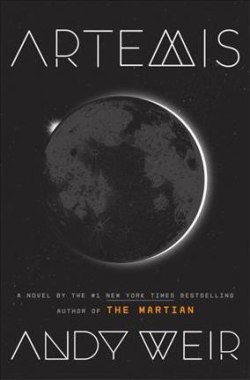
Book Review: Artemis by Andy Weir

Artemis by Andy Weir
Artemis
by Andy Weir
Crown, 2017

Artemis is the only city on the Moon. Established by the Kenya Space Corporation, it’s a series of habitable domes, filled with a mix of rich tourists and working class residents from myriad ethnic groups. It’s like the Wild West with few established laws, dominated by trade guilds.

A small bubble of life in the middle of a deadly and dangerous environment.

Jazz Bashara grew up in Artemis, the daughter of a Saudi Arabian welder with whom she’s had a falling out. An underachieving genius with a string of broken romantic relationships, she works as a low wage porter and she earns extra money on the side as a smuggler. She’s egotistical and bitter, smart and funny, strong and broken in equal measure.

One day, Jazz gets a job offer that may be too illegal even for her but which promises to pay enough to be worth it. Despite her reservations, she accepts. Next thing she knows, she’s wrapped up in a couple of murders and a Brazilian mafia family has sent an assassin to the Moon to hunt her down. To save her own life, she could end up risking the lives of everyone in Artemis.

And then there’s a new technology that holds untold riches for whoever controls it…

Continue reading “Book Review: Artemis by Andy Weir”

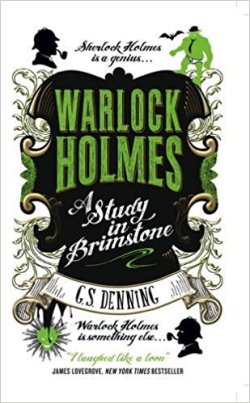
Book Review: Warlock Holmes by G. S. Denning

A Study in Brimstone by G. S. Denning
A Study in Brimstone
by G. S. Denning
Titan Books, 2016

I’m not a fan of Arthur Conan Doyle’s original Sherlock Holmes stories (although I’ve read all of them at least once, some more than once, and I’ve see all of the major BBC television adaptations). I dislike Victorian literature in general.

I’m also not much of a fan of contemporary paranormal fiction—I don’t dislike it but it’s not something I seek out.

So there’s really no reason why I should like G. S. Denning’s “Warlock Holmes” series as much as I do.

Because I kinda love it.

Continue reading “Book Review: Warlock Holmes by G. S. Denning”

Book Review: The Kill Society by Richard Kadrey

Cover of the book The Kill Society by Richard Kadrey
The Kill Society
by Richard Kadrey
Harper/Voyager, 2017

This review was first published by Booklist on June 7, 2017.

Sandman Slim is dead (for real this time) and abandoned in a desolate part of the Tenebrae, the land of the dead. He’s discovered by a motorized roving gang trailing destruction and death in its wake, led by a religious fanatic looking for an ultimate weapon to kill God. Slim runs into some old friends along the way. It culminates in a fight between angels at the gates of Heaven itself. And Wormwood is up to something, as always. All because Sandman Slim tried to break open Heaven. This is Kadrey’s version of a Mad Max movie laid out as a cautionary tale about religious fanaticism. It’s a fast-paced story and an ideal setting to show off more of his richly imagined hereafter. The ending puts Sandman Slim right where he most wants to be, but in the last position he ever wanted. This entry in the series is plenty entertaining, but there are a few too many coincidences to be believable. Kadrey’s social criticism is much more obvious than usual, and it hits closer to home.

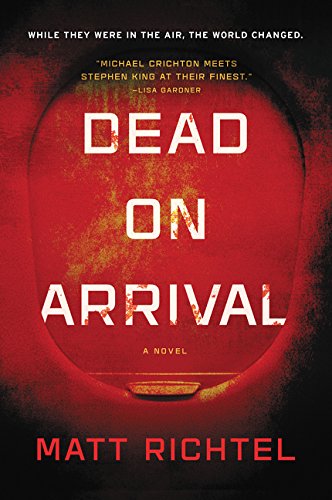
Book Review: Dead on Arrival by Matt Richtel

Cover of the book Dead on Arrival by Matt Richtel
Dead on Arrival
by Matt Richtel
Morrow, 2017

This review was first published by Booklist on May 31, 2017.

The promotional blurbs for Richtel’s latest compare it to Michael Crichton’s thrillers and Stephen King’s The Stand, and these comparisons aren’t without some merit. The story is similar in atmosphere and style to both suggestions, and it’s a cautionary tale about technology and science left unchecked. An airplane lands in a remote town and everyone on the ground appears to be dead. A disgraced doctor on board is the best hope to discover what’s going on. The first half of the novel is split between this mystery and flashbacks to the doctor’s past and his relationship to a particular individual who works for an online technology giant. A twist at the midpoint of the book radically changes the direction of the story, and the second half proceeds as a conventional race-against-the-clock thriller. The pacing is excellent, the science is detailed and believable, and the flashback structure is handled well. Richtel’s writing style is urgent, making this an enjoyable and gripping read.

Remembrance of Earth’s Past by Liu Cixin: A Critical Follow-Up

Shortly after I published my review of the “Remembrance of Earth’s Past” trilogy by Liu Cixin, I tweeted a link to it and @ referenced both the author and the two English language translators of the series, Ken Liu and Joel Martinsen. Shortly after that tweet, Ken posted a series of tweets in response.

I’m incredibly grateful that Ken took the time to respond. His tweets are insightful and his critique of my review is helpful. I’ve included them here with his permission. Please read through them.

https://twitter.com/kyliu99/status/858025429793468417 Continue reading “Remembrance of Earth’s Past by Liu Cixin: A Critical Follow-Up”

Book Review: Remembrance of Earth’s Past by Cixin Liu

Remembrance of Earths Past by Cixin Liu

The Three-Body Problem by Cixin Liu
(translated by Ken Liu)
Tor, 2014

The Dark Forest by Cixin Liu
(translated by Joel Martinsen)
Tor, 2015

Death’s End by Cixin Liu
(translated by Ken Liu)
Tor, 2016

In my review of Leviathan Wakes by James S. A. Corey, I compare reading it to reading Asimov’s Foundation when I was a kid.

I’m going to make the same comparison with the “Remembrance of Earth’s Past” series by Cixin Liu. Reading this awakens the same sense of discovery and amazement as reading Asimov when I was a child. Liu gifts us a story that’s astounding in scope and vision, with some of a biggest Big Ideas in science fiction.

The English translations of Liu’s work boast an admirable level of stylistic polish. There’s a spare and refreshing lyricism at work here. I’m as impressed with the quality of the translations as I am with Liu’s story.

This is what science fiction should be. I’m in awe of Liu’s imagination and accomplishment.

Continue reading “Book Review: Remembrance of Earth’s Past by Cixin Liu”

Further Ruminations on Jerusalem by Alan Moore

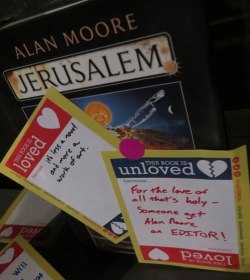
Reader comments left on a copy of Jerusalem by Alan Moore

Reader comments left on a copy of Jerusalem by Alan Moore

Photo from the ReBound event on March 21, 2017, hosted by the Young Friends of the Kansas City Public Library and KCUR’s Generation Listen KC at the recordBar in Kansas City, Mo.

Image © Kansas City Public Library. Used with permission.

After writing the single longest and most exhaustive review I’ve ever written for Jerusalem by Alan Moore, I find I still have more to say.

I’ve had conversations now with a few other people about this book and discovered that I’m in a minority in my opinion. Most people I know couldn’t stand it. Most didn’t finish it. Mostly, they found it too long, too wordy, too self-indulgent. The general reaction is that Moore desperately needed an editor to reel him in.

I get that. On some level, I feel this way, too. I spent quite a lot of the book convinced that he was over-indulgent and lacking writerly discipline.

However, as others have stated (and I quote Library Journal here), Jerusalem is “[m]ore a work of art than a novel.”

Continue reading “Further Ruminations on Jerusalem by Alan Moore”