Book Review: Remnants of Trust by Elizabeth Bonesteel

Cover of the book Remnants of Trust by Elizabeth Bonesteel
Remnants of Trust
by Elizabeth Bonesteel
Harper/Voyager, 2016

This review was first published by Booklist on September 15, 2016.

This second entry in the Central Corps series is wall-to-wall action. It starts with a bang, opens new vistas of political and corporate intrigue, and pulls readers along to an ending that will leave them wanting more. After the events of The Cold Between (2016), Elena Shaw and Greg Foster were court-martialed for their actions. But instead of punishment, they’re put back on board their ship and assigned to patrol the Third Sector. When Syndicate raiders attack and destroy a fellow Corps ship, they must partner with a PSI captain and her crew to pursue the attackers. Elena’s former crewmates and commander open old wounds, as the pursuit leads to the site of one of her worst memories. Worse yet, there’s a saboteur on board. Bonesteel’s characters are what really stand out amid all the action—the relationships between them ground everything in the story, though this novel ditches the romance that characterized its predecessor in favor of more straightforward military science fiction. Fans of David Drake’s Honor Harrington series will find much to enjoy here.

Book Review: City of Weird: 30 Otherworldly Portland Tales by Gigi Little

Cover of the book City of Weird: 30 Otherworldly Portland Tales by Gigi Little
City of Weird: 30 Otherworldly Portland Tales
by Gigi Little
Forest Avenue, 2016

This review was first published by Booklist on September 1, 2016.

The 30 stories collected here come from an impressive cast of authors. All stories are set in Portland, Oregon (you don’t need to know anything about Portland to enjoy them), and partake, to varying degrees, of the unique brand of weird that defines that city. Some center around specific landmarks (Powell’s bookstore makes several appearances), some reference the history of the town, and some treat the city only as a general setting. These stories range from highly speculative to more mainstream, from upbeat to cynical, silly to serious; stories of love and loss, humor and pathos, from the bizarre to the poetic. There’s even an illustrated comic. Some are wonderfully pulpy, and some are more modern. “Transformation,” by Dan DeWeese, uses an alien invasion as critique of mindless conformity; “Yay,” by Bradley K. Rosen, is a Christmas Krampus story of madness and indigence; “Waiting for the Question,” by Art Edwards, is a gritty urban fantasia featuring Alex Trebek. All of the stories are very good, making this a fun and recommended collection.

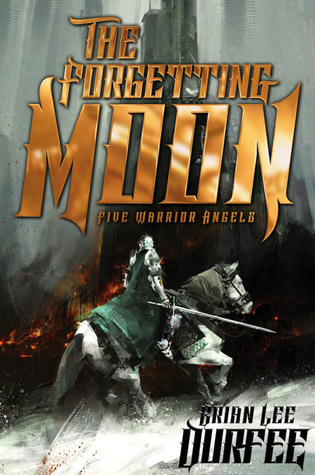
Book Review: The Forgetting Moon by Brian Lee Durfee

Cover of the book The Forgetting Moon by Brian Lee Durfee
The Forgetting Moon
by Brian Lee Durfee
Saga, 2016

This review was first published by Booklist on September 1, 2016.

A thousand years ago, the Five Warrior Angels rid the Five Isles of demons. Since then, their legends have given rise to religions, which now war for conquest. Many believe a prophesied apocalypse is near: some seek to hasten it, while a secret cult fights to prevent it. Magical weapons thought long lost are being found. But the legends may be lies, and the fate of the world depends on the daughters of a king, an assassin, a mysterious Vallè, and an orphan boy from a small fishing village. This is high fantasy in the vein of Stephen R. Donaldson or David Eddings, with generous helpings from George R. R. Martin. Durfee’s world building is exceptional: detailed and immersive, with a deep history and believable cultures. The plot is paced and driven, compellingly structured, with a conflict large enough to fuel forthcoming titles in the series. Some of the concepts and characters feel derivative, though archetype, and, unfortunately, the writing is inconsistent. For fans of high fantasy, the less-than-stellar writing shouldn’t detract from enjoyment of the world and the many entertainments of the story.

Book Review: Everfair by Nisi Shawl

Cover of the book Everfair by Nisi Shawl
Everfair
by Nisi Shawl
Tor, 2016

This review was first published by Booklist in August, 2016.

Shawl’s first novel offers a steampunk-influenced alternate history of the Belgian Congo from 1889 to 1919. It envisions what would have happened if Fabian Socialists from Europe and African American missionaries had purchased land in the Congo from King Leopold and established a free state made up of native Africans, freed slaves, European settlers, and even Chinese laborers. Told from the perspectives of several different characters, it touches on themes of colonialism, sovereignty, religion, prejudice, sexuality, and identity. It is structured episodically, with each chapter offering a snapshot from the lives of the characters and the history of Everfair; some chapters could almost stand on their own as short stories. Taken together, these snapshots weave an engrossing tapestry of the history and humanity of what might have been for the Congo. The work is elegant, rendered with masterful craft in simple, compelling language—a tour de force of Shawl’s tremendous ability to create deeply nuanced characters. This is a beautifully told, important entry in the movement for greater diversity in sf.

[Author’s Note: I regret not giving this book a starred review. It deserved one—it was one of the most interesting and compelling SF novels of the year and I think it will take its place as in important work in the history of the genre. Sometimes the true value of a book takes time to realize.]

Book Review: The Hike by Drew Magary

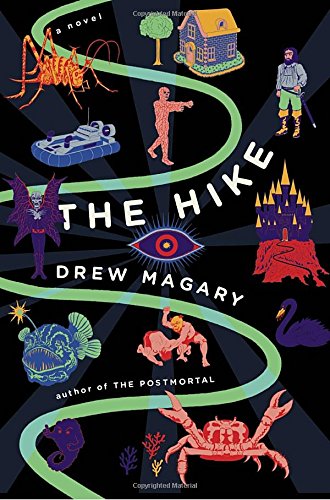
Cover of the book The Hike by Drew Magary
The Hike
by Drew Magary
Viking, 2016

This review was first published by Booklist in July, 2016.

In simplest terms, this is the story of a man, Ben, who goes for a walk in the woods, gets very, very lost, and stumbles into a fantastic and monstrously dangerous realm from which he can’t seem to escape. The bizarre, funny, and haunting narrative achieves a dream-like quality, with events that feel simultaneously random and inevitable. Magary’s writing echoes the compelling lyricism of folktales, which juxtaposes surprisingly well with his sarcastic sense of humor. More than anything else, this novel may remind readers of classic adventure computer games like King’s Quest. The main character is faced with an arbitrarily circumscribed world and limited options, and the story unfolds in ways that are strange and disturbing. Just like those old computer games, it has an addictive quality; you need to know what’s going to come next. The book stumbles a bit at the end, trying too hard to be philosophical, and there’s a last-second twist that’s harmless but also unnecessary. Otherwise, an engrossing and imaginative read.

Book Review: The Swarm by Orson Scott Card and Aaron Johnston

Cover of the book The Swarm by Orson Scott Card and Aaron Johnston
The Swarm
by Orson Scott Card and Aaron Johnston
Tor, 2016

This review was first published by Booklist in July, 2016.

Earth survived the attack of the first Formic scoutship. But can the heroes of that first invasion save humanity from the full fleet that’s on its way? The Swarm picks up a few years after the conclusion of the First Formic War series. Earth has begun preparing a desperate defense. The Hegemon, Polemarch, and Strategos are in place, and the newly minted International Fleet is working with corporate forces to build an armada and weapons as fast as possible. Will it be enough? And can humanity overcome the dangers posed by political machinations, careerism, international squabbles, and petty bureaucracy? The greatest threat may be ourselves. This is a solid outing, well-paced and exciting with a mounting sense of crisis, grand in scope yet human in perspective. Fans of the Ender Universe and the First Formic War series will be eager for this one—readers will find the same central characters as well as some new faces. It will be particularly satisfying for longtime fans to finally see the creation of the Battle School.

Book Review: Leviathan Wakes by James S. A. Corey

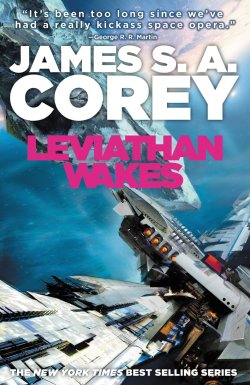
Leviathan Wakes by James S. A. Corey
Orbit Books, 2011
Cover Art by Daniel Dociu

The first real science fiction I ever read was Isaac Asimov’s Foundation trilogy. I read it when I was in 3rd grade. It remains one of the most transformative experiences of my life. It single-handedly awoke my passion for science fiction. It inspired my ongoing fascination with science—particularly cutting-edge theoretical cosmology.

More than that: Foundation (along with Star Wars) taught me that human imagination doesn’t need to be limited to only the world we know. Our dreams and stories can encompass the Universe and beyond, aliens and environments vastly different from us and ours.

While reading Leviathan Wakes by James S. A. Corey, I kept flashing back to my experiences with Asimov in 3rd grade. I kept recalling what it was like to have my mind opened by Asimov’s stories.

Continue reading “Book Review: Leviathan Wakes by James S. A. Corey”

Book Review: The Dark Side by Anthony O’Neill

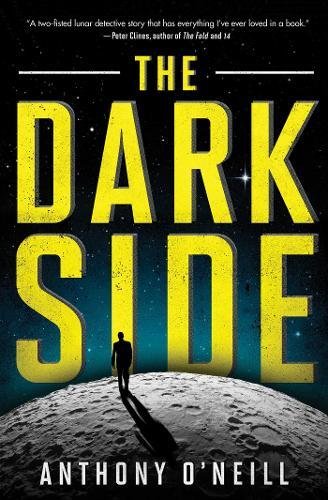
Cover of the book The Dark Side by Anthony O'Neill
The Dark Side
by Anthony O’Neill
Simon & Schuster, 2016

This review was first published by Booklist on June 1, 2016.

**STARRED REVIEW** There’s been a series of terrorist acts in the anarchic criminal city of Purgatory on the far side of the Moon. Damien Justus is the cop tasked with solving these crimes—but he’s a newbie ex-pat from Earth who doesn’t understand the complicated politics involved. Meanwhile, a murderer is making his or her way toward Purgatory through the back country of the Moon’s so-called “dark side” and leaving bodies in the wake. This is a smart, rollicking sf-detective-noir genre-blend with a delightfully dark and snide sense of humor. It’s formulaic in the best way possible—a good cop, a corrupt system, powerful forces at play—with excellent characterizations, first-class world building, fast-paced plotting, a main character you want to root for, and a genuinely sinister villain. While the ultimate solution of the mystery is a little pat, it’s satisfying, and the book’s ending isn’t quite what you expect. This incredibly entertaining novel is unmitigated fun to read, and is sure to be at the top of many genre readers’ favorite books of the year.

Book Review: The Perdition Score by Richard Kadrey

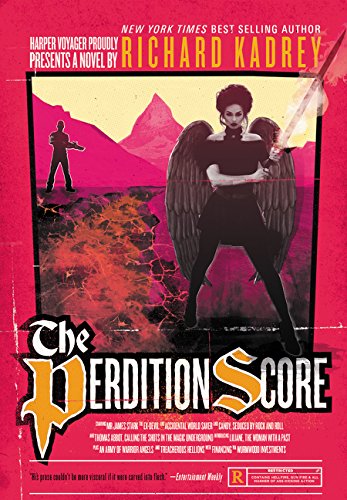
Cover of the book The Perdition Score by Richard Kadrey
The Perdition Score
by Richard Kadrey
Harper/Voyager, 2016

This review was first published by Booklist on June 1, 2016.

James Stark (aka Sandman Slim) is living the closest thing he can to a normal life: he works for the Sub Rosa, and he has a girlfriend and a social life (well, he’s part of an underground fight club). Then a dying angel gives him a vial of mysterious “black milk” and another angel tries to kill him for it. The Wormwood Corporation is up to no good, a kid goes missing, and too many coincidences start to pile up. His friends are in danger, Heaven is in revolt, and everyone’s soul hangs in the balance. Now Stark needs to find a way to get back to Hell . . . . The eighth entry in Kadrey’s Sandman Slim series is well paced, gritty, cool, funny, and insightful. The dialogue is whip-smart, the characters remain compelling, and Stark continues to evolve in surprising ways. Not only is this a welcome return for existing fans, it’s also easy for new readers to follow along. This fun and rewarding book has an ending that will leave readers eager for the next one.

Book Review: The Everything Box by Richard Kadrey

Cover of the book The Everything Box by Richard Kadrey
The Everything Box
by Richard Kadrey
Harper, 2016

This review was first published by Booklist on April 1, 2016.

Coop is a thief who specializes in thaumaturgical snatch and grabs. His cohorts are poltergeists, strongmen, telekinetic lockpickers, and women who can make things invisible—one of whom is his ex-girlfriend. But wait, there’s more. Like an angel who was supposed to destroy the Earth after the Flood but botched the job, cops who specialize in “peculiar science,” gangsters, bumbling demon-worship cults, vampires, werewolves, zombies, and monsters of all ilk, all living in secret in a surreal version of L.A. And it seems that everyone wants Coop to steal them a very special box. The Everything Box is what you would get if Carl Hiaasen and Kinky Friedman had written Good Omens (1990) instead of Neil Gaiman and Terry Pratchett. It offers a similar setting of the real world blended with the paranormal—complete with a looming apocalypse—but the writing has an edgier, racier sense of humor. The story is fast, the twists keep turning, and the resolution is satisfying. This strongly PG-rated, ribald romp is a good set-up for a potential new series.