Libraries & Third Party eContent Services

It’s self-evident that more and more library content is being delivered digitally – ebooks, emagazines, digital movies and TV shows, digital music, databases. It’s even more self-evident to point out that many of the third party econtent services to which libraries subscribe suck in some truly horrendous ways. Sometimes the content is bad, or the selection is too limited, or the user interface is frustratingly complicated and unfriendly. (It’s frequently a combination of these.)

Few of these services – if any – live up to the expectations we have for them, or the standards we set for non-econtent library services. Third party econtent subscription services always seem to make us feel like we’re compromising too much.

From what I can see, when it comes to econtent services, opinion amongst library professionals gets divided into two camps:

  1. Those who believe that services that aren’t good enough are still better than nothing when it comes to offering patrons what they want.
  2. Those who believe that it’s far worse to provide a not-good-enough service than none at all.

In the last year, I’ve flip-flopped between these two camps more than a few times.
Continue reading “Libraries & Third Party eContent Services”
Libraries & eBooks

[NOTE: This is a piece I originally posted on Facebook on March 23, 2012. It’s already somewhat dated, even only a year later, but I want it to live on my blog here because it addresses an issue that I believe is still, and will continue to be, one of the central questions librarians face in a world where more and more of our content is being delivered digitally via third party services.]

Is not good enough better or worse than nothing at all?
Continue reading “Libraries & eBooks”

Another Librarian’s Response to "What’s a Library?"

I love Rita Meade’s (@ScrewyDecimal) reaction piece to Michael Rosenblum’s op-ed “What’s a Library?” that was posted by the Huffington Post on May 8, 2013.

A Librarian’s Response to “What’s a Library?” (posted on Book Riot on May 13, 2013)

[With apologies for plagiarizing her title.]

Let’s be kind – let’s give Mr. Rosenblum the benefit of the doubt and assume he was honestly trying to critique the current state of libraries in some kind of difficult to discern attempt to help.

He still failed.
Continue reading “Another Librarian’s Response to "What’s a Library?"”

Interesting Article: The Reading Brain in the Digital Age

The Reading Brain in the Digital Age: The Science of Paper versus Screens by Ferris Jabr (posted by Scientific American on April 11, 2013)

When I was in grad school, I had an idea to conduct research into the neurological underpinnings of reading on paper vs. computer screens vs. ebooks. While my vision for the project was beyond the scope of what I could accomplish in the program and thus never got started, I’ve continued to be obsessed with this facet of our modern technology. I’ve written about it on this blog before. I continue to follow research being done on the subject.

This article from Scientific American sums up well what we currently know about how our brains process written language through different presentation media. It appears that I’m correct in my belief that these acts of reading are qualitatively different as far as our brains are concerned.

As librarians, we need to account for these differences in our resources – especially when it comes to education and literacy initiatives.

Library Website Design, Part III: Give Them Paths to Follow, Not Points to Click

When it comes to making sure that all of our services are available on our library’s website, the best strategy is to make access intuitive and obvious.

The mistake that’s all too easy to make (and all too frequently made) is to assume that this means putting points of access right there on the home page.

At certain point, though, this requires either:

  • Putting so many points of access on the home page that everything gets lost in the chaos and the site loses any sense of focus at all; or,
  • Prioritizing certain services over others and keeping many points of access off the home page – which triggers our fear that we might fail to address every conceivable patron need in an obvious way, and unintentionally defines unwanted implications regarding the perceived relative value of these services.

To reiterate what PC Sweeney said: “Too many choices creates confusion.”
Continue reading “Library Website Design, Part III: Give Them Paths to Follow, Not Points to Click”

Library Website Design, Part II: The Tyranny of Choice, and an Ode to the Reference Interview

Consider the way that many library websites handle online database collections: we list every database we have and let the patron find the one they need. We offer alphabetical listings of our databases, we have categorized lists… we offer multiple points of access to try and provide any given patron an option that might fit how they want to interact with the site.

But there’s a fundamental flaw in this use-case:

It puts the burden of identifying and locating appropriate resources on the patron. The general category and topics lists help somewhat – but the patron still needs to decide which category they need to drill through, and then they need to assess each database offered in that category to determine which might best serve their purpose.
Continue reading “Library Website Design, Part II: The Tyranny of Choice, and an Ode to the Reference Interview”

Library Website Design, Part I: The Trader Joe’s Principle

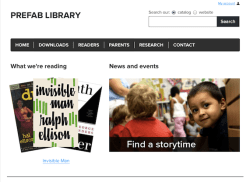
Prefab
Prefab from Influx (image used with permission)
Designing a library website is challenging. Most commercial websites – e-commerce sites, for example, or promotional sites for businesses – have clear purposes and limited use-cases.

Libraries, by contrast, offer a staggering array of services to a wide variety of users.

How do you design for that? How do you focus your layout and navigation without sacrificing the visibility of all your myriad resources and services? How do you promote certain services without ostracizing patrons who are seeking services that aren’t being promoted?
Continue reading “Library Website Design, Part I: The Trader Joe’s Principle”

Thoughts on the True Nature of Ebooks

Stuart Kelly at The Guardian has an interesting take on the potential new reality of ebooks:

Why ebooks are a different genre from print (posted March 26, 2013)

I’ve long been advocating for the multimedia potential of ebooks but I hadn’t really thought about the data-gathering and non-private nature of the medium before.

On a deeper level, I’d like to see more longitudinal studies done on information comprehension and retention when reading ebooks, as well as direct neurological mapping of ebook reading vs. print. I’m curious to know how our pre- and sub-conscious minds deal with the physical differences in the delivery mechanisms.
Continue reading “Thoughts on the True Nature of Ebooks”

Again with the Ebooks & Online Library Services & Patron Privacy

Defining a Less Polarizing Position

I was talking to my wife about my concerns over patron privacy and library ebook lending for Kindles, and she presented me with an argument that pretty well demolished my entire principled stance on this issue:

Ebook services for libraries don’t carry any really controversial or potentially dangerous stuff anyway. Ereaders are for fluff – all the data shows that pretty much no one uses them for serious reading or scholarship. There’s no real danger in exposing ebook lending records because there’s nothing there to get patrons in trouble in the first place.
Continue reading “Again with the Ebooks & Online Library Services & Patron Privacy”