The Silent Corner is Dean Koontz’s version of a hard-boiled detective thriller: an off-the-books FBI detective on a personal mission, a rash of mysterious suicides, a cabal of men wielding a genuinely terrifying new technology. As always, Koontz renders his characters ably and the plot is perfectly paced. This is a tense, taut, and foreboding novel to kick off a new series.
I didn’t enjoy it at all.
There are two reasons why I didn’t enjoy this book. The first problem I have is his writing style.
If immigration is debated only in terms of whether it benefits the economy, politicians begin to divide people into two categories: “valuable” and “illegal.” When countries make people illegal, the world comes apart. When we agree to talk about people as cogs, we lose our humanity.
I hate how our culture has decided that economics is the only thing that matters. That every aspect of our society is assessed predominately—if not exclusively—in economic terms. Education, healthcare, the environment, arts and humanities, science and engineering, technology, civil rights, immigration and refugees, and on and on and on…
This review was first published by Booklist on September 1, 2017.
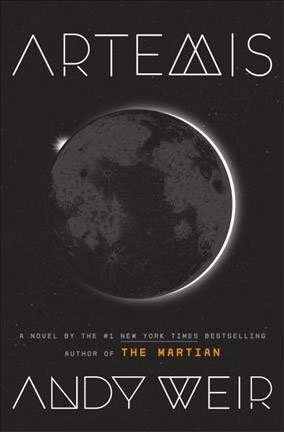
**STARRED REVIEW** Jazz Bashara grew up in Artemis, the only city on the moon. She’s a young, misanthropic, underachieving genius who side-hustles as a smuggler. One day, she takes on a job that proves too dangerous and finds herself wrapped up in murder and an interplanetary struggle for control over a new technology worth billions. This exciting, whip-smart, funny thrill-ride boasts a wonderful cast of characters, a wide cultural milieu, and the appeal of a striking young woman as the main character. It’s one of the best science fiction novels of the year—but to make it clear, Artemis is not The Martian (2011) redux. Tone, characters, structure are all very different. It’s more traditional sf and lacks the cheery novelty that characterized Weir’s famous first novel. The setting is just as detailed and scientifically realistic, but science isn’t the focus this time. Weir’s sarcastic humor is on full display, but Jazz delivers it with an anger that Watney (The Martian‘s protagonist) never had. The Martian appealed to a broad audience beyond regular sf fans, and Weir’s second novel will be in high demand, thanks to that, though it may not be to everyone’s taste.
Eclipse shadow through tree leaves, over half occluded. Downtown Kansas City, August 21, 2017. Image property of John Keogh
In the early afternoon on August 21, 2017, a total solar eclipse traversed the United States from Oregon to South Carolina. In Kansas City, morning storms cleared and blue sky opened just in time to view the event, from the first sliver of moon shadow through totality. It’s the only total solar eclipse I’ve witnessed. I’m struggling to put the experience into words.
I started studying astronomy in 2nd and 3rd grade. In 3rd grade, we had to write an essay about what we wanted to be when we grew up and the title of mine was “When I Grow Up I Want to Be a Cosmologist.” Space was my first fascination and my first love.
I’ve seen partial solar eclipses in person. I’ve seen images of total eclipses and they’re beautiful. Astronomically speaking, eclipses aren’t that rare or complex. They happen pretty often, simple mass body physics.
So I expected the total eclipse to be spectacular, gorgeous. I expected it to be cool and interesting. I expected to be fascinated by it and by the effect it had on insects and animals. I expected to completely geek out over it.
After the Flare by Deji Bryce Olukotun Unnamed, 2017
This review was first published by Booklist on August 22, 2017.
A solar flare knocks out electrical grids and technology worldwide. Countries along the equator survive best, so Nigeria ends up with the only functional space program on Earth. With the help of a former NASA engineer, the Nigerian astronauts undertake a daring rescue operation to the International Space Station. Meanwhile, terrorists threaten the launch, and excavations unearth an ancient secret. Olukotun weaves together a broad spectrum of subjects: engineering and archaeology, culture and politics, biohacking and cybernetic animal technology, ancient tribal wisdom and magical stones. With such an original premise, the story is well-paced, with compelling characters and a subtle sense of humor. It’s particularly fascinating to witness the culture shock of an African-American man now living in his ancestral homeland. If there’s a weak spot, it’s that the proffered scientific explanation for the more fantastical elements is a bit strained. This is a solidly enjoyable dystopian near-future novel set in Nigeria, with an international cast of characters, written by a Nigerian-American author.
Some years ago, I was working on the overhire crew for a touring event gig in Chicago. One of the touring crew was an older guy who used to be a rock roadie. I got assigned to work with him and so we got to talking.
He mostly talked about his experiences of the Civil Rights movement in the United States during the 1950s and ’60s. He was in high school and college at the time, and he participated in the protests and sit-ins. He fought hard for equal rights. It remains a defining experience of his life.
This guy was raised by middle class white Republican parents in a solid middle class white Republican neighborhood. According to him, many of his fellows stood and protested with him in support of the Civil Rights movement. They supported equal rights because they believed in the importance of individual merit. A person’s success or failure in life should be determined by their own abilities and effort.
Systemic inequality is anathema to the doctrine of individual merit. If the system assigns unearned advantages or disadvantages to people, it renders individual ability and effort largely meaningless. They all wanted an equal playing field where individuals could prove themselves.
While this guy remained committed to continuing civil rights efforts over the years, he watched most of his fellows change their stance as they all grew older, many to the point where they now actively oppose current civil rights movements. He told me he was trying hard to understand how that happened.
I admit, I do find this idea fascinating: using storytelling techniques to envision new products and services, craft new vision and mission statements, new marketing campaigns, new strategic initiatives. I’d be interested to see what, if anything, comes of it.
I had a roommate once who had never read any SF before we moved in together. She saw my collection of science fiction and decided to give it a try.
She grabbed a book off my shelf at random—a far future, hard scifi title. Pretty advanced for her first exposure to the genre. She found it very frustrating.
She had no problem getting into the characters or the plot. She understood the science well enough and enjoyed how the author extrapolated it. She didn’t get too tripped up over the genre-specific vocabulary, either, although she did have to ask me what some of the acronyms stood for.
The problem was the setting. She couldn’t make sense of the world of the story, the environment. She didn’t know what things were and couldn’t picture them. Presented with an imagined far-future, alien setting, she felt lost and disoriented.
She was frustrated because she thought she was supposed to understand it. She felt like she was missing something, some key that would bring the world of the story into focus. Something to make it all make sense.
Artemis is the only city on the Moon. Established by the Kenya Space Corporation, it’s a series of habitable domes, filled with a mix of rich tourists and working class residents from myriad ethnic groups. It’s like the Wild West with few established laws, dominated by trade guilds.
A small bubble of life in the middle of a deadly and dangerous environment.
Jazz Bashara grew up in Artemis, the daughter of a Saudi Arabian welder with whom she’s had a falling out. An underachieving genius with a string of broken romantic relationships, she works as a low wage porter and she earns extra money on the side as a smuggler. She’s egotistical and bitter, smart and funny, strong and broken in equal measure.
One day, Jazz gets a job offer that may be too illegal even for her but which promises to pay enough to be worth it. Despite her reservations, she accepts. Next thing she knows, she’s wrapped up in a couple of murders and a Brazilian mafia family has sent an assassin to the Moon to hunt her down. To save her own life, she could end up risking the lives of everyone in Artemis.
And then there’s a new technology that holds untold riches for whoever controls it…




 John the Librarian