Why Tech Can’t Replace Manufacturing

[Author’s Note: This is adapted from a tweetstorm I posted recently.]

Many people yearn for the return of American manufacturing. Other people correctly point out that manufacturing is never coming back. The latter argue that we need to focus on creating new jobs, new kinds of jobs, and they point to the modern tech industry for this.

But the tech industry isn’t a present-day equivalent of our bygone manufacturing economy. It can’t replace it.

Consider: In the ’50s, a man who never finished high school could get a job working a factory line, and that job paid enough for them to raise a family and own a home. Nothing much, no frills, but a decent quality of life. They could learn new skills on the job and advance to more skilled positions. They could have a career and retire in some comfort.

Name one job in today’s tech industry that you can get without a high school diploma. Name one tech job that you can get without a college degree.

Continue reading “Why Tech Can’t Replace Manufacturing”

This Is Why I Love Libraries

In my post about hatred the other day, I mentioned my life motto: “I am human: nothing human is alien to me.” (In the Latin, “Homo sum, humani nihil a me alienum puto.”)

And all at once it strikes me—this is why I have always loved libraries.

Libraries give me access to the full depth and breadth of humanity. All of our thoughts and ideas, our hopes and dreams, our fears, our creativity and cultures, our histories, our plethora of worldviews and philosophies and beliefs.

All our stories.

I can access all of this through my library. If my library doesn’t have it on the shelf, they can find it and get it for me.

Libraries are where I go to learn how to be human, in all our myriad aspects.

The Mystery of Hatred

“I am human: nothing human is alien to me.”

I first read this in a book by Isaac Asimov when I was in grade school. It wasn’t until college that I learned that this is an English translation of the Roman writer Terence. It remains one of the most powerful sentences I’ve read. If any single idea serves as my deepest moral code, it’s this.

I even made it the subtitle of this blog.

To me, this statement defines my responsibility to try and understand. All human feeling, all human thought and action, should be comprehensible to me. If human nature is capable of encompassing it, I should be able to relate to it. No matter how dark or twisted, no matter how bright or saintly—if it’s human, then by definition it shouldn’t be alien to me.

Continue reading “The Mystery of Hatred”

2016: My Year in Reading

All of the data that follows was collected by me throughout the year using a combination of Google Sheets and Google Calendar. All seasonal and monthly calculations are based on the date each title was completed. Average days to read titles are based on the number of days actually spent reading each title, and not necessarily the full span from begun date to completed date.

A complete list of all the books I read in 2016 is at the bottom of this post.


I read 70 books in 2016. This year I overwhelmingly read fiction:

Continue reading “2016: My Year in Reading”

The Genres that Scare Me

I spend a fair amount of time talking about the importance of diversity in our stories and reading culture. I fully support the #WeNeedDiverseBooks movement. I’ve made a commitment to increase the diversity of my own reading, both in terms of authors and characters.

I read two posts over the past couple of weeks which spin the idea of diverse reading in a slightly different direction:

I Can’t Even with Librarians Who Don’t Read Diversely by Molly Wetta (posted on Bookriot, August 12, 2016)

Call to Action: Get Out There and Read Something You Are “Afraid” Of by Becky Spratford (posted on RA for All, August 22, 2016)

Normally, we talk about diverse books in terms of the ethnicity and cultures of characters, authors, and story traditions. What speaks to me about the two articles linked above is the call to increase the diversity of the genres I read. The call to “read outside [my] own taste and interest” (from Bookriot), to read things I dislike or that scare me to try (as per the RA for All post).

Continue reading “The Genres that Scare Me”

Diverse Books for My Kids

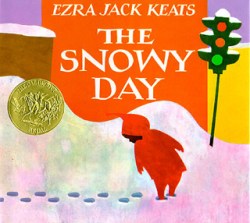
The Snowy Day by Ezra Jack Keats
Viking Press, 1962

Please read this article from Rumaan Alam. What he has to say is essential.

We Don’t Only Need More Diverse Books. We Need More Diverse Books Like The Snowy Day.
by Rumaan Alam (published by Slate, August 2, 2016)

We need diverse books to be sure, but those must be part of a literature that reflects our reality, books in which little black boys push one another on the swings, in which little black girls daydream about working in the zoo, in which kids of every color do what kids of every color do every day: tromp through the woods, obsess about trucks, love their parents, refuse to eat dinner. We need more books in which our kids are simply themselves, and in which that is enough.

Continue reading “Diverse Books for My Kids”

Childhood Memory: Found

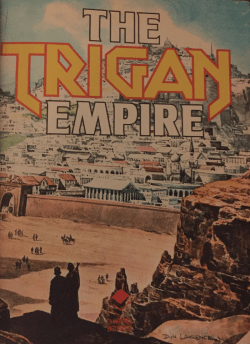
The Trigan Empire by Mike Butterworth & Don Lawrence
The Trigan Empire written by Mike Butterworth & artwork by Don Lawrence
Chartwell Publishers, 1978
(inside title page)

Without further ado, I present my long lost childhood memory:

The Trigan Empire, written by Mike Butterworth with artwork by Don Lawrence.

This is definitely the book my siblings and I read as kids. As fragmentary as my memories of it are, I was shocked at how familiar it felt to read through it again as an adult. I found that I remembered almost every page as it was revealed to me. And I was delighted to discover that the copy I received via ILL came from a public library in my home state. Seems appropriate.

The Trigan Empire was a comic that ran from 1965 to 1982, published in Britain by Fleetway, with Butterworth and Lawrence as the primary writer and artist. It ran as a serial installment in an educational magazine focused on science. The hardbound novel-length book my siblings and I read was an omnibus collection of the earliest stories from the comic, published in the United States in 1978 by Chartwell.

What’s it about?

Continue reading “Childhood Memory: Found”

Searching for a Childhood Memory

When my siblings and I were in early grade school at the beginning of the 1980s, we discovered a strange book in the children’s section of our local public library. It was a heftier tome than we’d ever seen on the shelves, oversized and thick—close to 200 pages. Barring encyclopedias, we’d only seen books this big in the adult section or on our parents’ bookshelves at home.

But the best part was that this strange book was a comic book!

Today we’d call it a graphic novel but we hadn’t heard that term back then. We checked it out, brought it home, and each read through it a couple of times.

My memories of reading this book are difficult to properly describe: fragmentary, dissociative, surreal, and dreamlike all come close. I recall that my in-the-moment experience of reading it as a little kid was similar: surreal, dreamlike, dissociative, fragmentary. I had a difficult time keeping the narrative strung together as a cohesive whole in my head.

It was the most challenging thing I’d read up to that point in my life.

Continue reading “Searching for a Childhood Memory”

Virtues, Dogs & Love: Scattered Thoughts in the Wake of the Orlando Tragedy

When I was a kid, I was taught the basic virtues: love, honesty, charity, hope, loyalty, modesty, tolerance, temperance, courage. I was taught that these are what we should strive for, as individuals and as a culture.

As a kid, I remember thinking how well these virtues describe a happy, healthy dog. As an adult, it sometimes seems that too many humans have too little of any of these virtues.

This is a picture of me and our dog.

Addison & Me, June 10, 2016
Addison & me, June 10, 2016

She doesn’t care what color my skin is, what country I come from, what my gender is, who I want to have sex with (or don’t want to have sex with), what god I believe in (or none at all), how much money I make.

None of that matters.

She only knows that we love her as best we can and she loves us. We keep her safe, sheltered, fed. We play with her and show her the world. We’re kind to her and we will never hurt her. And for that, she gives us everything she has.

That’s all that matters. Everything else is just vanity.

Dogs love so easily. There’s never any struggle for them to love unconditionally. It’s their default state.

But they don’t hate. They may learn to fear, they may become conditioned to be distrustful, but their fear is only ever that: fear. It never translates into hatred. Dogs can learn fear and caution through repeated experience but they never hold grudges.

And no matter how damaged or distrustful or fearful a dog may be, they can always be led back to love.

It’s so easy to love each other. Why do we have such a hard time with it?