
Today was Day 10 of #LibFaves19 on Twitter. Every December, librarians across the land take to Twitter to list their top 10 favorite books published that year. For the complete list of my Top 10 #LibFaves19, go here:
Year End Lists Are Coming
Starting Monday, December 9, I’ll be posting my top 10 books from 2019 on Twitter under the hashtag #LibFaves19. In preparation for this, I’ve begun creating my overall favorites and least favorites lists for the year, and prepping for my annual Year in Reading post.
This has me thinking more about my recent post on reader burnout. And I’ve made a decision:
This will be the last year I do a Year in Reading post for a while. I won’t track my reading in 2020.
This will be the sixth year I’ve tracked it and it’s not working for me. I think it does more harm than good. My hope is taking that obligation off my plate will relieve much of the stress I feel around my reading life. Which means I won’t be able to do a comprehensive Year in Reading report next year.
I’ll still participate in #LibFaves and I’ll continue to post lists of my favorites and least favorites of the year. But no more tracking or reporting. I just want to let my reading be what it is without worrying about it.
Book Review: Scientists Who Changed History edited by Victoria Heyworth-Dunne, Kathryn Hennessy, Rose Blackett-Ord, Kim Bryan, Andy Szudek, Debra Wolter
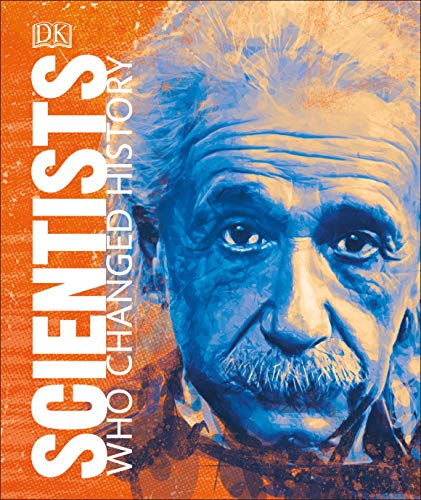
edited by Victoria Heyworth-Dunne, Kathryn Hennessy, Rose Blackett-Ord, Kim Bryan, Andy Szudek, Debra Wolter
DK, 2019
This review was first published by Booklist on December 1, 2019.
**STARRED REVIEW** This comprehensively researched and beautifully designed reference work contains profiles of over 80 scientists, mathematicians, engineers, and inventors whose work changed the world. Each profile is between 1-4 easily digested pages that cover essential information. What differentiates this work from similar ones is its scope and inclusivity. It covers history from approximately 650 BCE through the present and includes figures from Europe, Asia, the Middle East, and the modern Americas. Effort has been made to include many women, too often overlooked by historians for their contributions to science. A broad scope of scientific fields are represented: mathematics, physics, chemistry, biology, medicine, technology, geology, oceanography. All the giants are here: Archimedes, Galileo, Newton, Curie, Einstein, Turing, Goodall. Alongside them are lesser known but equally impressive people: Zhang Heng, Al-Khwarizmi, Hildegard of Bingen, António Egas Moniz, Tu Youyou. Profiles are organized based on historical era to highlight the progression of scientific thought and discovery. At the end of each section is a directory of other individuals from the era, each accompanied by a paragraph of basic information. This is an excellent resource to both browse and to serve as a launch pad for further research. Appropriate for middle school and up.
This title has been recommended for young adult readers:
YA/Curriculum Support: Easily digested, inclusive profiles of influential scientists will bolster both STEM and history coursework.
Reader Burnout
I want to talk about reader burnout. I think this is something a lot of readers deal with but I find that being a librarian makes it worse.
I’m a voracious reader. I always have been. It’s a core pillar of my self-identity.
But there are times when I just don’t want to read, sometimes for few days and sometimes for couple weeks or more. I feel guilty about this. Readers read, right? Reading is a good thing and we should all do more of it, right?
I didn’t used to feel this way. I used to read as much as I wanted, when I wanted. And that was that. It was all good.
Some of this sense of guilt started when I became a librarian. As a librarian, I feel a professional obligation to read as widely as I can. It’s part of my job to understand the reading landscape so I can help guide patrons through it.
A lot of this pressure to read more started when I began tracking my annual reading a few years ago. Tracking reading is something a lot of librarians do. I hadn’t ever thought to do it until I saw how popular it is on library Twitter and the librarian blogosphere. For many people, it’s a useful thing.
For me, it turned reading into a focus on quantity rather than quality. Continue reading “Reader Burnout”
Book Review: Lost Transmissions: The Secret History of Science Fiction and Fantasy by Desirina Boskovich

by Desirina Boskovich
Abrams, 2019
This review was first published by Booklist on November 15, 2019.
Mainstream histories of sf and fantasy cover the main eras, the big names, the important publications and events. But there’s more to any history than just the mainstream. There are obscure authors, forgotten works, and a plethora of what might have beens, plus the myriad ways sf and fantasy have influenced and been influenced by art, design, architecture, fashion, music, and fandom. Lost Transmissions explores some of these often-overlooked pieces of the history of sf and fantasy. How would the genre be different if Jules Verne had successfully published the first novel he submitted? If William Gibson’s screenplay for Alien III had been made, or if E.T. had been a creepy goblin movie? From the sf fashion of David Bowie’s Ziggy Stardust, to the Afrofuturism of Janelle Monáe’s music, to Soleri’s architecture of arcology (best recognized as Luke Skywalker’s dome house on Tatooine,) to contributed essays by a roster of luminaries reflecting on their favorite obscurities, this is a fascinating enrichment of the history of sf and fantasy.
A Selfish Argument for Diverse Stories
I made a choice over the past several years to mostly abandon mainstream SF and seek out work by and for people from other countries and cultures, Indigenous people, LGBTQIA2+ people, minorities, etc.
I’ve had a couple conversations recently which have challenged me to examine this choice more deeply and articulate the reasons why I made it.
It has a great deal to do with my commitment to diversity and building empathy. I support #OwnVoices and #WeNeedDiverseBooks. Sharing stories is how we forge understanding and respect. I want to embody this belief in my personal reading choices.
But I also have a more selfish reason: my own personal entertainment.
Visions of Leadership
My dad likes to tell a story about a man he knew who was the head of a college. Every summer, this man would take a weekend to go out to a cabin in the middle of nowhere, all by himself, unconnected and alone. He brought along a blank notepad and a pen. On the top of the first page, he’d write, “Five Years.” He’d flip a few pages in and write “Ten Years” at the top of the page, and then “Twenty Years” a few pages later. He’d spend the weekend jotting down everything he could think of that he wanted the college to do in the next five-to-twenty years.
One summer, his weekend came to an end and he looked at his notepad. He had four or five things written on the “Five Years” page, just a couple things written on the “Ten Years” page, and nothing under “Twenty Years.” When he got back home, he tendered his resignation. He believed that if he didn’t have a vision for the organization, then he wasn’t the right person to lead it anymore.
This story worries me.
Book Review: The Best of Uncanny edited by Lynne M. Thomas and Michael Damian Thomas
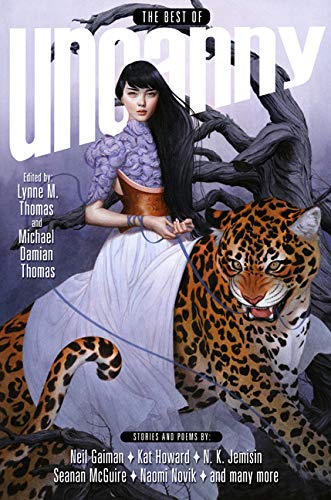
edited by Lynne M. Thomas and Michael Damian Thomas
Subterranean, 2019
This review was first published by Booklist on November 1, 2019.
**STARRED REVIEW** Multi-award-winning Uncanny Magazine has been the preeminent publisher of speculative short fiction, poetry, and nonfiction since 2014, and is renowned for offering its contributors tremendous creative freedom. Authors published by Uncanny are a roster of the greatest sf writers of the present era: Neil Gaiman, N. K. Jemisin, Charlie Jane Anders, Seanan McGuire, Naomi Novik, and many, many more. The works in this anthology are the best of the best in the genre, from science fiction to fantasy to weird tales to poetry, representing a stunning diversity of styles and perspectives, from the Hugo award-winning “Folding Beijing,” by Hao Jingfang to a female empowerment parable, “Monster Girls Don’t Cry,” by A. Merc Rustad. Language and family tie into technology and posterity in “Restore the Heart to Love,” by John Chu; “Clearly Lettered in a Mostly Steady Hand,” by Fran Wilde visits a nightmarish circus freak show; “And Then There Were (N-One),” by Sarah Pinsker is what happens when Being John Malkovich meets Agatha Christie. This anthology contains a gluttonous surfeit of narrative riches. The works in this collection are inventive, gorgeous, occasionally difficult, and immensely rewarding. Truly, the best of Uncanny.
Cultures of Storytelling

edited by Hope Nicholson
Bedside Press, 2016
I’ve made it a point over the past several years to seek out SF written by people from other countries and cultures, Indigenous people, LGBTQIA2 people, minorities, etc. The most recent book I read was Love Beyond Body, Space, and Time: An Indigenous LGBT Sci-fi Anthology. I was discussing it with a friend and he asked me:
“Are the stories any good?”
I had been talking about the Two Spirit and queer authors and characters, the Indigenous settings and perspectives, the prefatory material which lay out the history and politics and which argue the need for stories like these—the important context surrounding these stories—and my friend noticed I wasn’t talking much about the stories themselves. Thus, his question.
I fumbled a bit to answer. Yes, some are good, a few excellent, some just OK. I voiced my belief that there’s benefit to reading stories like these even if they’re not good: I appreciate these works because of what they can teach me, how they challenge my assumptions and show me very different experiences and understandings of the world.
But the truth is also this: I don’t always know whether the stories I read are any good. I’m not always qualified to assess the quality of these works.
Book Review: Medieval Bodies: Life and Death in the Middle Ages by Jack Hartnell
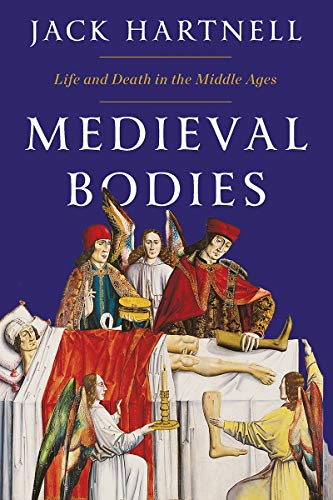
by Jack Hartnell
Norton, 2019
This review was first published by Booklist on October 15, 2019.
**STARRED REVIEW** Medieval Bodies was a Sunday Times History Book of the Year when published in Britain last year, and it is now coming out in the U.S. Hartnell, a professor of the history of art and visual culture, brings together his vast knowledge of medieval art and writing to examine how European and Middle Eastern peoples of the time understood the workings of their own bodies. He starts with medical texts and illustrations, explores the legacy of classical Greek and Roman teachings, and surveys the general practices of medicine and healing during this period. But he doesn’t stop there. The body becomes a metaphor for medieval culture overall that informs our understanding of everything from the politics, religious beliefs, and class structures of this swath of Western history to the arts and interpersonal relationships of those who peopled it. Armed with Hartnell’s telling, readers will reassess their traditional view of the Middle Ages. Far from a Dark Age of superstition and ignorance, this was a time of curiosity, inquiry, and experimentation—a collision of the legacies of the past and the realities of the present. His knowledge and insight are impressive, and he shows uses [sic] with wit and humor.
 John the Librarian