Design & Ethics

I think everyone who has any role in the design of user interaction environments, no matter how peripheral or glancing (and yes – book displays and public service desks count!) should read this article.

Manipulation and Design by Jon Kolko (posted by UX Mag, July 23, 2013 – Article No. 1059)

His critiques are spot-on and his conclusion is important. Such considerations may seem overwrought in the context of public service desk or book display design, but the ethical responsibility to help is appropriate for all—and especially for libraries.
Unintentional Knowledge

I love this article! It’s a wonderful summary of the real value of browsing the stacks.

Unintentional Knowledge: What We Find When We’re Not Looking by Julie Alves (posted on The Chronicle of Higher Education, June 23, 2013)

As a professional librarian, I’m obsessed with the phenomenon of serendipitous discovery. Some of the most rewarding learning experiences of my life came to me by chance; I discovered some of my favorite books and authors simply by browsing the shelves at the library and allowing interesting things to catch my eye. I’m more grateful for these unlooked-for experiences than I can say.

With new digital content services, and with more libraries going towards automated storage and retrieval systems for their print collections, we’re challenged to find ways to maintain the possibility of non-targeted browsing and unanticipated discovery under these new conditions.
Continue reading “Unintentional Knowledge”

Libraries & eBooks

[NOTE: This is a piece I originally posted on Facebook on March 23, 2012. It’s already somewhat dated, even only a year later, but I want it to live on my blog here because it addresses an issue that I believe is still, and will continue to be, one of the central questions librarians face in a world where more and more of our content is being delivered digitally via third party services.]

Is not good enough better or worse than nothing at all?
Continue reading “Libraries & eBooks”

Traditional vs. Modern Libraries

Kim Leeder at In the Library with the Lead Pipe wrote a fantastic and thought-provoking piece about the rhetoric that characterizes the debate between so-called “traditional” and “modern” libraries. It’s worth the read!

Adventures in Rhetoric: The Traditional Library (posted on June 5, 2013)

This is the comment I left on her article:

We get so caught up in comparing the form and practical functioning of different types of libraries that it becomes all too easy to believe that these forms and functions are the definition of a library. We must remember that form and function are merely strategies employed to try and achieve deeper goals and serve essential functions in our communities.
Continue reading “Traditional vs. Modern Libraries”

Another Librarian’s Response to "What’s a Library?"

I love Rita Meade’s (@ScrewyDecimal) reaction piece to Michael Rosenblum’s op-ed “What’s a Library?” that was posted by the Huffington Post on May 8, 2013.

A Librarian’s Response to “What’s a Library?” (posted on Book Riot on May 13, 2013)

[With apologies for plagiarizing her title.]

Let’s be kind – let’s give Mr. Rosenblum the benefit of the doubt and assume he was honestly trying to critique the current state of libraries in some kind of difficult to discern attempt to help.

He still failed.
Continue reading “Another Librarian’s Response to "What’s a Library?"”

Interesting Article: The Reading Brain in the Digital Age

The Reading Brain in the Digital Age: The Science of Paper versus Screens by Ferris Jabr (posted by Scientific American on April 11, 2013)

When I was in grad school, I had an idea to conduct research into the neurological underpinnings of reading on paper vs. computer screens vs. ebooks. While my vision for the project was beyond the scope of what I could accomplish in the program and thus never got started, I’ve continued to be obsessed with this facet of our modern technology. I’ve written about it on this blog before. I continue to follow research being done on the subject.

This article from Scientific American sums up well what we currently know about how our brains process written language through different presentation media. It appears that I’m correct in my belief that these acts of reading are qualitatively different as far as our brains are concerned.

As librarians, we need to account for these differences in our resources – especially when it comes to education and literacy initiatives.

Library Website Design, Part III: Give Them Paths to Follow, Not Points to Click

When it comes to making sure that all of our services are available on our library’s website, the best strategy is to make access intuitive and obvious.

The mistake that’s all too easy to make (and all too frequently made) is to assume that this means putting points of access right there on the home page.

At certain point, though, this requires either:

  • Putting so many points of access on the home page that everything gets lost in the chaos and the site loses any sense of focus at all; or,
  • Prioritizing certain services over others and keeping many points of access off the home page – which triggers our fear that we might fail to address every conceivable patron need in an obvious way, and unintentionally defines unwanted implications regarding the perceived relative value of these services.

To reiterate what PC Sweeney said: “Too many choices creates confusion.”
Continue reading “Library Website Design, Part III: Give Them Paths to Follow, Not Points to Click”

Library Website Design, Part II: The Tyranny of Choice, and an Ode to the Reference Interview

Consider the way that many library websites handle online database collections: we list every database we have and let the patron find the one they need. We offer alphabetical listings of our databases, we have categorized lists… we offer multiple points of access to try and provide any given patron an option that might fit how they want to interact with the site.

But there’s a fundamental flaw in this use-case:

It puts the burden of identifying and locating appropriate resources on the patron. The general category and topics lists help somewhat – but the patron still needs to decide which category they need to drill through, and then they need to assess each database offered in that category to determine which might best serve their purpose.
Continue reading “Library Website Design, Part II: The Tyranny of Choice, and an Ode to the Reference Interview”

Library Website Design, Part I: The Trader Joe’s Principle

Prefab
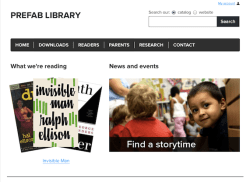
Prefab from Influx (image used with permission)
Designing a library website is challenging. Most commercial websites – e-commerce sites, for example, or promotional sites for businesses – have clear purposes and limited use-cases.

Libraries, by contrast, offer a staggering array of services to a wide variety of users.

How do you design for that? How do you focus your layout and navigation without sacrificing the visibility of all your myriad resources and services? How do you promote certain services without ostracizing patrons who are seeking services that aren’t being promoted?
Continue reading “Library Website Design, Part I: The Trader Joe’s Principle”