Information Tsunami

One of the primary functions of libraries – and librarians – especially in our current Information Age, is to sort through the ocean of information available to us and find the truly worthwhile bits. We talk about “tsunamis” of information, “deluges” of information, and we’re acutely aware of how easily people can get lost and drown in it all.

I recently had an experience that made all this very real to me.

Bookgate

Continue reading “Information Tsunami”

Libraries & Third Party eContent Services

It’s self-evident that more and more library content is being delivered digitally – ebooks, emagazines, digital movies and TV shows, digital music, databases. It’s even more self-evident to point out that many of the third party econtent services to which libraries subscribe suck in some truly horrendous ways. Sometimes the content is bad, or the selection is too limited, or the user interface is frustratingly complicated and unfriendly. (It’s frequently a combination of these.)

Few of these services – if any – live up to the expectations we have for them, or the standards we set for non-econtent library services. Third party econtent subscription services always seem to make us feel like we’re compromising too much.

From what I can see, when it comes to econtent services, opinion amongst library professionals gets divided into two camps:

  1. Those who believe that services that aren’t good enough are still better than nothing when it comes to offering patrons what they want.
  2. Those who believe that it’s far worse to provide a not-good-enough service than none at all.

In the last year, I’ve flip-flopped between these two camps more than a few times.
Continue reading “Libraries & Third Party eContent Services”

Another Librarian’s Response to "What’s a Library?"

I love Rita Meade’s (@ScrewyDecimal) reaction piece to Michael Rosenblum’s op-ed “What’s a Library?” that was posted by the Huffington Post on May 8, 2013.

A Librarian’s Response to “What’s a Library?” (posted on Book Riot on May 13, 2013)

[With apologies for plagiarizing her title.]

Let’s be kind – let’s give Mr. Rosenblum the benefit of the doubt and assume he was honestly trying to critique the current state of libraries in some kind of difficult to discern attempt to help.

He still failed.
Continue reading “Another Librarian’s Response to "What’s a Library?"”

QWERTY & UX

The Lies You’ve Been Told About the Origin of the QWERTY Keyboard by Alexis C. Madrigal (posted by The Atlantic, May 2013)

This article strikes me for two reasons:

  1. It’s a great example of a user-focused design process – the QWERTY keyboard was designed based on user feedback to serve user need.
  2. It’s a great example of why a user-focused design process can’t ever stop – because this isn’t the best design for users anymore.

It’s so tempting, once a design project is pushed out to the public, after a lengthy development and feedback process, to say, “We’re done!” This is what happens with many, many websites in particular. But really – once it’s public, that’s just the beginning of the next stage. The user feedback should never stop.

Shakespeare and the Notion of Love

It would seem that this is going to be the year for Romeo and Juliet. There’s a new movie coming out (starring the wonderful Hailee Steinfeld) and the Kansas City Repertory Theatre has a production slated for their 2013-2014 season.

I’ve never particularly liked Romeo and Juliet. I feel like I should but I’m always disappointed by productions of it. For this, I blame a professor from my freshman year of undergrad. The reason I’m consistently disappointed by productions of Romeo and Juliet is because I have yet to see a production of it based on his interpretation.

This professor’s interpretation of Romeo and Juliet starts with the line Juliet says to Romeo after they have their first kiss – she tells him, “You kiss by the book.”

She’s not speaking metaphorically – she’s referring to an actual book. And she obviously doesn’t think that kissing by it is a good thing.
Continue reading “Shakespeare and the Notion of Love”

Library Website Design, Part III: Give Them Paths to Follow, Not Points to Click

When it comes to making sure that all of our services are available on our library’s website, the best strategy is to make access intuitive and obvious.

The mistake that’s all too easy to make (and all too frequently made) is to assume that this means putting points of access right there on the home page.

At certain point, though, this requires either:

  • Putting so many points of access on the home page that everything gets lost in the chaos and the site loses any sense of focus at all; or,
  • Prioritizing certain services over others and keeping many points of access off the home page – which triggers our fear that we might fail to address every conceivable patron need in an obvious way, and unintentionally defines unwanted implications regarding the perceived relative value of these services.

To reiterate what PC Sweeney said: “Too many choices creates confusion.”
Continue reading “Library Website Design, Part III: Give Them Paths to Follow, Not Points to Click”

Library Website Design, Part II: The Tyranny of Choice, and an Ode to the Reference Interview

Consider the way that many library websites handle online database collections: we list every database we have and let the patron find the one they need. We offer alphabetical listings of our databases, we have categorized lists… we offer multiple points of access to try and provide any given patron an option that might fit how they want to interact with the site.

But there’s a fundamental flaw in this use-case:

It puts the burden of identifying and locating appropriate resources on the patron. The general category and topics lists help somewhat – but the patron still needs to decide which category they need to drill through, and then they need to assess each database offered in that category to determine which might best serve their purpose.
Continue reading “Library Website Design, Part II: The Tyranny of Choice, and an Ode to the Reference Interview”

Library Website Design, Part I: The Trader Joe’s Principle

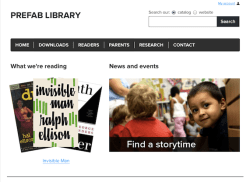
Prefab
Prefab from Influx (image used with permission)
Designing a library website is challenging. Most commercial websites – e-commerce sites, for example, or promotional sites for businesses – have clear purposes and limited use-cases.

Libraries, by contrast, offer a staggering array of services to a wide variety of users.

How do you design for that? How do you focus your layout and navigation without sacrificing the visibility of all your myriad resources and services? How do you promote certain services without ostracizing patrons who are seeking services that aren’t being promoted?
Continue reading “Library Website Design, Part I: The Trader Joe’s Principle”

Again with the Ebooks & Online Library Services & Patron Privacy

Defining a Less Polarizing Position

I was talking to my wife about my concerns over patron privacy and library ebook lending for Kindles, and she presented me with an argument that pretty well demolished my entire principled stance on this issue:

Ebook services for libraries don’t carry any really controversial or potentially dangerous stuff anyway. Ereaders are for fluff – all the data shows that pretty much no one uses them for serious reading or scholarship. There’s no real danger in exposing ebook lending records because there’s nothing there to get patrons in trouble in the first place.
Continue reading “Again with the Ebooks & Online Library Services & Patron Privacy”

Advertising In Libraries? Maybe…

I’ve been hearing about public libraries selling advertising space as a source of funding for a couple of years now. I keep thinking that I should be opposed to this idea on principle – and I’m fascinated to discover that I’m not.

I think this article does a fine and concise job of summarizing the issue:

Advertising in Libraries? Considering the Consequences (posted on Non-Profit Quarterly, February 27, 2013)

Selling advertising space in libraries has the potential to be a substantial source of funding. Librarians are well aware of the dangers this type of arrangement poses; any library wishing to go this route will make sure to include language in any such contacts that explicitly deny advertisers the right to have any say in operational or policy decisions.
Continue reading “Advertising In Libraries? Maybe…”